
Reviewed · POMPEII TOURS
Pompeii Small Group Tour with an Archaeologist
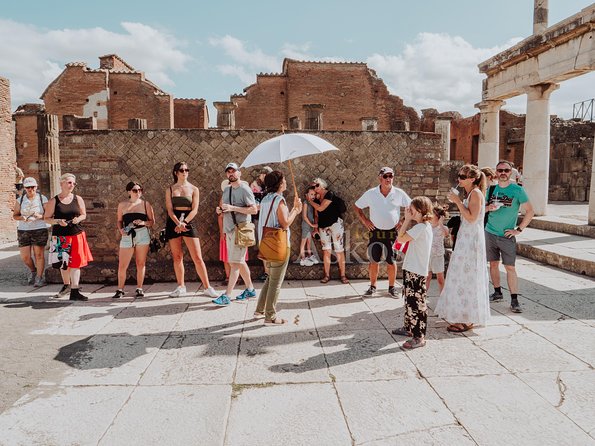
Pompeii is vast, and its streets can feel like a maze without a guide to show you what matters. I like this tour for two reasons: an archaeologist puts the buildings and their details in context, and the route covers major sights such as the Forum, the plaster casts, and the House of the Faun in about two hours.
I also like that the tour ends inside the archaeological site, leaving you positioned to ask your guide how to continue exploring. The trade-off is a brisk route through uneven streets, and a group of up to 20 may feel large if you want an intimate conversation at every stop.
At a glance
- See the city’s civic center: The Basilica and Forum help explain how Pompeii worked as a public place, not just a collection of ruins.
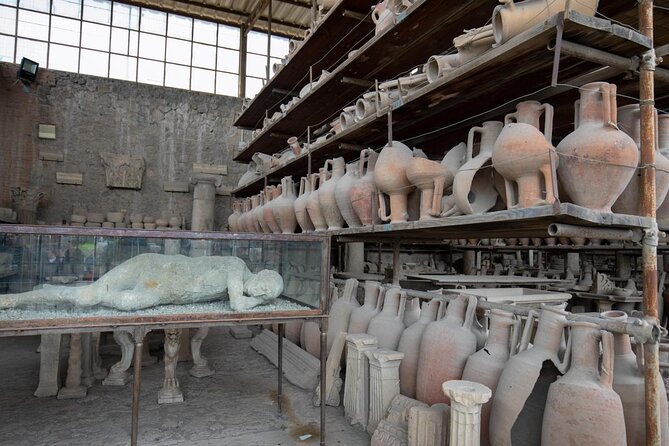
- Pause at the plaster casts: The Granaries of the Forum hold casts of victims, a sobering encounter with the eruption’s human cost.
- Step inside famous homes and baths: The House of Menander, Stabian Baths, and House of the Faun reveal different sides of Roman life.
- Hear an archaeologist’s perspective: Guides such as Alessandra, Paolo, Teresa, and Amedeo have been praised for clear explanations, storytelling, and patience. Your guide will vary.
- Plan for stone underfoot: Expect uneven paving, ramps, steps, and some steep climbs. Sturdy shoes, water, sun protection, and realistic mobility expectations matter.
Why a guided walk helps in Pompeii

Pompeii is not a compact site where you can simply follow a path from one famous building to the next. It is an ancient city, and the scale can make it hard to judge what you are seeing or how far apart the important places are. A guide gives you a route and a running explanation, so you spend less time guessing and more time understanding.
This is especially useful at the start of a visit. The Basilica and Forum may look like open spaces framed by columns and stone, but they were central to public and commercial life. A guide can help you read the remains as parts of a functioning city rather than as isolated monuments.
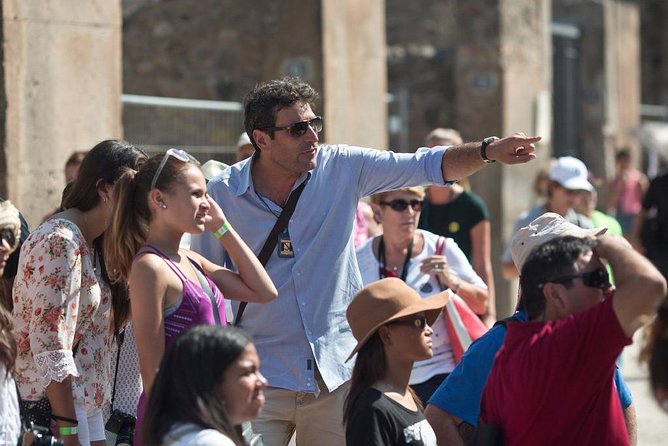
The tour is led by a licensed guide with an archaeological background. That does not mean every stop becomes a formal lecture. The best guides make room for questions and use buildings, decoration, and the site itself to tell the story. Several guides have been praised for making Pompeii understandable to adults and children alike, and for balancing information with humor and a manageable pace.
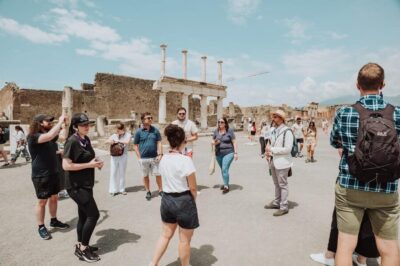
The group can include up to 20 people. That is small enough to move as a guided party, but not a private tour. At popular stops, you may need to wait your turn to get a closer look or hear a detail. Headsets are provided for groups of 16 or more, which helps when the group is spread out.
More Pompeii visits near Pompeii:
- Pompeii: Entry Ticket and Guided Tour with an Archaeologist
★ 4.8 · 19,459 reviews - Pompeii: Entry Ticket with Optional Audio Guide
★ 4.2 · 12,360 reviews - Pompeii: Small Group Tour with an Archaeologist
★ 4.8 · 12,264 reviews
Starting at Porta Marina Superiore
Meet at the Porta Marina Superiore entrance, at Via Villa dei Misteri, 2. Look for the guide holding a sign with Askos Tours on it. The tour includes a Pompeii Express ticket and is described as having skip-the-line entry, so the guide takes care of getting the group inside rather than leaving you to navigate the entrance on your own.
Arrive on time. Pompeii is large, and catching up with a group that has already entered can be difficult. One late-arrival dispute ended with the delayed party unable to join the guide, so don’t count on being able to find the group by phone once the tour is underway. The site’s size and unreliable signal can make that a poor plan.
The first part of the route takes about 10 minutes at the entrance, including meeting the guide and getting started. From there, you begin moving through the ruins. The listed stops add up to roughly two hours, but walking between them also takes time, so expect a focused overview rather than a slow visit to every room.
From the Basilica to the Forum

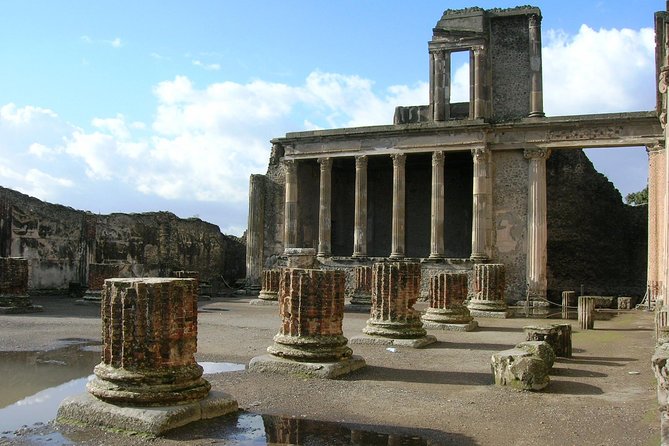
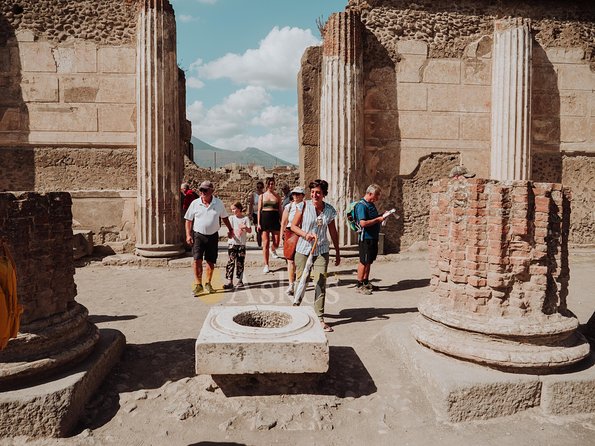
The Basilica is the first major stop. It was an open, porticoed building used for business and other public activities, and its remaining structure offers a good introduction to Pompeii’s civic life. You’ll have about 15 minutes here, enough to orient yourself and hear what the building was for, though not enough to linger over every architectural detail.
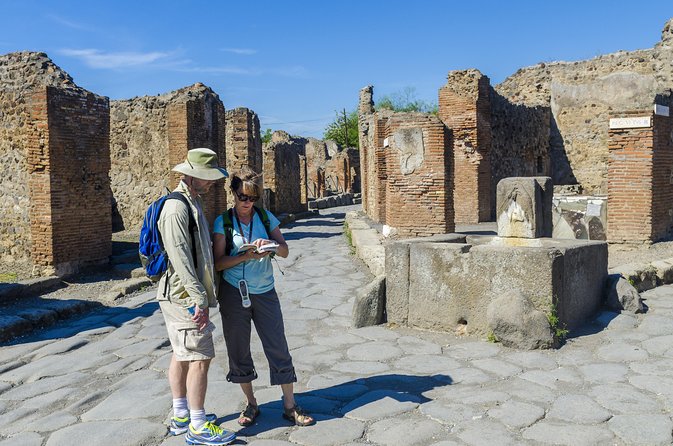
Next comes the Forum, the city’s main square. It is one of the most useful places to pause and think about Pompeii as a connected community: public buildings, shops, and religious spaces gathered around a shared center. The stop is about 10 minutes, so listen for the guide’s explanation of the square’s role and notice how the surrounding structures frame the space.
These early stops matter because they give the rest of the walk a framework. Without that context, the houses and baths can seem like attractive remnants with no clear relationship to one another. With it, you can start to picture a city organized around work, public life, and home.
The Granaries and the human cost of the eruption
At the Granaries of the Forum, you’ll see marble tables and fountain basins, as well as plaster casts of victims. A cast of a dog and a tree are also part of the display. The objects give a sense of what decorated homes and entrances, while the casts bring the eruption’s human consequences close.
The planned stop is about 15 minutes. It can be emotionally affecting, and it deserves more than a quick glance. The casts are not merely curiosities: they make the scale of the disaster personal. Your guide can help set the scene and explain what you are looking at, but this is also a place to take a quiet moment.
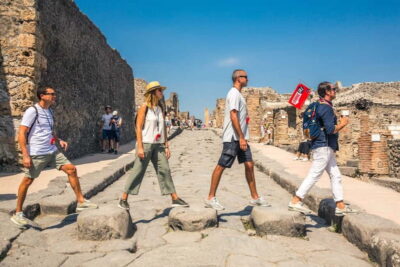
Afterward, the route follows one of Pompeii’s main streets. The original paving is part of the experience, but it is also a practical warning. Stone surfaces are uneven, and walking here is not like strolling on a smooth city pavement. Keep your attention on your footing, especially while listening or taking photographs.
More small-group tours near Pompeii:
- Naples: Pompeii & Mt Vesuvius All-Inclusive Small Group w/ Lunch
★ 4.5 · 2,748 reviews - From Naples: Amalfi Coast & Pompeii Small Group Tour
★ 4.5 · 2,135 reviews - Pompeii and Herculaneum Small Group Tour with an Archaeologist
★ 5.0 · 1,350 reviews - Pompeii: Small-Group Tour of Pompeii and Herculaneum
★ 4.8 · 867 reviews
A wealthy home at the House of Menander
The House of Menander is one of Pompeii’s most notable private residences, valued for its architecture, decoration, and contents. The stop lasts around 15 minutes. It offers a contrast with the public spaces you’ve already seen: here, the focus shifts to how a well-to-do household was laid out and presented.
A guide can point out details that are easy to pass over when you are moving through a large home on your own. Frescoes and mosaics are among the visual highlights on this route, and the House of Menander is a good place to pay attention to the relationship between rooms and decoration. The time is limited, so you may not see every corner at leisure.
This is one reason the tour works well as an introduction. It directs your attention to a few significant spaces and helps you understand why they matter. If you want a long, unhurried look at domestic architecture, plan to spend more time in Pompeii beyond the guided portion.
Baths, brothel, and everyday life

The Stabian Baths occupy a large area and are described as the oldest thermal complex in the city. The stop is about 15 minutes. Baths were an important part of Roman urban life, and their scale helps show that they were more than a place to wash. The ruins also give you a change of scene after the streets and houses.
The Lupanar, Pompeii’s best-known brothel, is another 15-minute stop. It is a famous site, but its significance goes beyond the novelty of the subject. It offers a glimpse into a part of city life that is less visible in the grand public spaces and wealthy homes. Crowds can gather at well-known sites, so be prepared to take in the guide’s explanation while moving through.
Together, these two stops widen the picture of Pompeii. The baths speak to shared public routines; the brothel points to commerce and private encounters. The tour gives each a short, direct visit, rather than asking you to interpret the remains alone.
The House of the Faun and the theaters
The House of the Faun was one of Pompeii’s largest private residences. Its size makes it a striking example of domestic wealth, and the guide can help you understand the scale of the property as you pass through. The scheduled stop is about 15 minutes, enough for an overview and a closer look at selected features, but not a full exploration of the house.
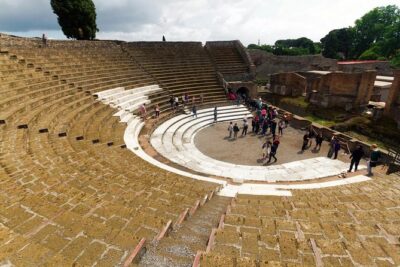
The route then includes a brief stop at the Odeon, also called the Teatro Piccolo. After that, you visit the Teatro Grande, the city’s largest and most important theater, for about 10 minutes. These final stops show another side of Pompeian life: entertainment and public gathering.
Theater visits make a fitting end to a highlights tour because they bring the city’s social life back into view. By this point, you have seen civic spaces, homes, baths, commercial life, and performance venues. The route does not cover every corner of Pompeii, but it gives you a useful cross-section of the city.
What the two-hour format can and cannot do
Two hours is a sensible length if you want structure without committing to a full day of guided walking. Guides have been praised for making the visit feel efficient without rushing, and for pointing out places to explore on your own afterward. Still, Pompeii is too large for a two-hour tour to be complete. Think of this as an orientation and highlights walk, not an exhaustive visit.
The route also involves a lot of walking on uneven ground, with steps, ramps, and some steeper sections. Wear sturdy, comfortable shoes. In summer, bring sunglasses, sunscreen, and a small bottle of water; shade is limited in parts of the site. The tour runs in rain or shine, so dress for the forecast.
The activity is not recommended for people with mobility difficulties or impairments. Mobility scooters are not allowed. If you need a more suitable arrangement, contact the operator about a private tour before booking. Children must be accompanied by an adult. For visitors under 18, bring an ID card or passport.
Small dogs are permitted under specific conditions: no more than 10 kilograms and no taller than 40 centimeters. They must be leashed, carried in your arms inside buildings, and you must collect after them. Service animals are also allowed.
Is $35.67 good value?
At $35.67 per person, the price includes the Pompeii Express entry ticket, a licensed archaeologist guide, and the small-group format. Food, drinks, and transportation are not included. For a site where navigation can eat up time and the meaning of the ruins is not always obvious, the guide is a substantial part of the value.
You are paying for both access and interpretation. A map can help you find the Forum or a famous house, but it cannot answer questions or explain the details as you encounter them. The guide’s archaeological background is especially useful when you want to know what a building was for, how it fits into the city, and what remains visible today.
There is a trade-off: the group may reach 20 people, and the tour follows a set route. If you want a quiet, flexible visit with plenty of time at each house, a private guide or independent exploration may suit you better. If you want a clear overview at a moderate price, this tour makes a practical case for itself.
After the guided portion, you may want to continue exploring. The tour finishes inside the ruins, and some people have stayed to see more on their own. Before the group disperses, ask your guide how to reach the exits and what nearby areas are worth prioritizing. The House of the Mysteries is not on the standard route, so ask in advance if you are hoping to include it or find out whether an extension is available.
Who should book this Pompeii tour?
I’d choose this tour if it is your first visit and you want an expert to help you make sense of the city’s main sights. It is also a good fit for families with older children or teens who can manage the walking, especially if they respond well to a guide who tells stories rather than simply naming buildings.
You may prefer a private or self-guided visit if you need a highly flexible pace, want to focus on a specific area, or find uneven surfaces difficult. And if you are arriving from elsewhere, arrange your transport separately: travel to Pompeii is not included.
With a 4.8 rating from 6,593 reviews and 96% of travelers recommending it, the tour has a strong track record, though the experience depends on the guide and the group. A small number of complaints point to delays, headset problems, or a long stationary explanation. Arrive promptly, speak up if you cannot hear, and ask the guide for help with pacing or directions.
Book it if you want an archaeologist-led introduction that covers the big civic spaces, striking homes, and human traces of Pompeii in two hours. Bring good shoes, water, and time to stay longer if you can. If you want every corner at your own pace, treat the tour as a starting point rather than the whole visit.
FAQ
How long is the Pompeii small-group tour?
The tour lasts approximately two hours.
Where does the tour meet?
Meet at Porta Marina Superiore, at Via Villa dei Misteri, 2. The guide will hold a sign with Askos Tours on it.
Is Pompeii admission included?
Yes. The Pompeii Express entrance ticket is included.
How large is the group?
The maximum is 20 people per guide. Headsets are provided for groups of 16 or more.
What should I bring?
Wear comfortable shoes and bring a small bottle of water. Sunglasses and sunscreen are recommended in summer.
Can I cancel for a refund?
You can cancel for a full refund at least 24 hours before the tour starts. Cancellations made less than 24 hours before the start are not refunded.
Recently added near Pompeii
- Capri Tour from Pompeii, Vico Equense & Castellammare di Stabia★ 4.5 · 57 reviews
- Capri, Sorrento and Pompeii Private Tour★ 5.0 · 3 reviews
- Capri, Blue Grotto, Sorrento & Pompeii Private Tour★ 5.0 · 12 reviews
- Day Trip to Capri, Blue Grotto, Sorrento & Pompeii Entry Tickets★ 5.0 · 12 reviews
- Day Trip to Capri, Sorrento and Pompeii from Rome★ 5.0 · 6 reviews
- 3-Days Audio Guide for Pompeii, Herculaneum, Vesuvius and Naples★ 5.0 · 7 reviews
- Minivan Tour | Amalfi Ravello and Pompeii with driver★ 4.5 · 11 reviews
- Amalfi, Ravello & Pompeii: private tour with no-traffic (8-hour)★ 5.0 · 4 reviews
Pompeii Tours, compared.
Pompeii: Entry Ticket and Guided Tour with an Archaeologist
Read our review →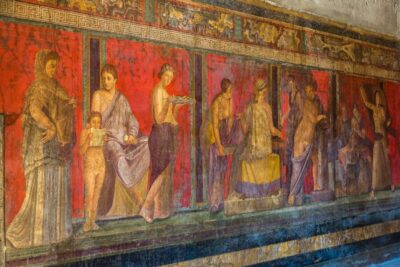
Pompeii: Entry Ticket with Optional Audio Guide
Read our review →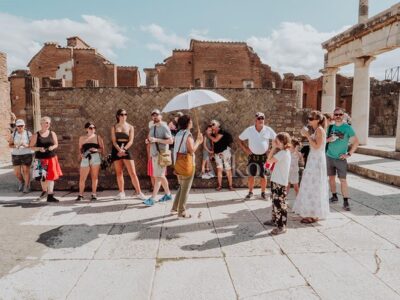
Pompeii: Small Group Tour with an Archaeologist
Read our review →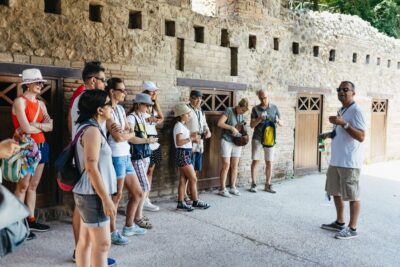
Naples or Sorrento: Full-Day Pompeii and Mount Vesuvius Tour
Read our review →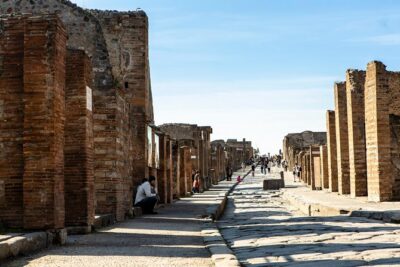
Pompeii & Mt.Vesuvius Day Tour from Naples with Pizza Lunch
Read our review →
Pompeii & Mt Vesuvius All-Inclusive Small Group w/ Lunch
Read our review →Browse the lists this tour appears in