
Reviewed · POMPEII TOURS
Pompeii Skip-the-line Tour with Archaeologist Guide
Pompeii makes more sense when someone can explain what you are looking at. On this two-hour walk, an archaeologist guide leads you through the ancient streets and connects ordinary details, such as wheel ruts and shop counters, to Roman daily life. I like two things about this format: the guide’s field experience can reveal details you might pass on your own, and the group is capped at 16, small enough for questions and conversation.
The trade-off is time. Pompeii is enormous, and two hours gives you a guided introduction, not a full visit. You also need to reach the meeting point yourself, and the confirmation is for the guided tour, not a ticket you can use to enter the ruins on your own.
At a glance
- Archaeologist-led walk: Guides such as Lello and Italo have drawn praise for explaining the site through their archaeological work and experience.
- A manageable group: The tour has a maximum of 16 people, a more personal scale than a large coach group.
- Major Pompeii sights: Expect highlights that can include the forum, theaters, baths, gymnasium, House of Menander, and Lupanare.
- Two hours on your feet: You walk over original streets and lava rock, so comfortable shoes matter.
- Admission included, with a condition: Your tour confirmation works with the guide. It is not a separate ticket for entering independently.
- No transfer or meal: You make your own way to Pompeii, and food is not included.
Starting at Hotel Vittoria
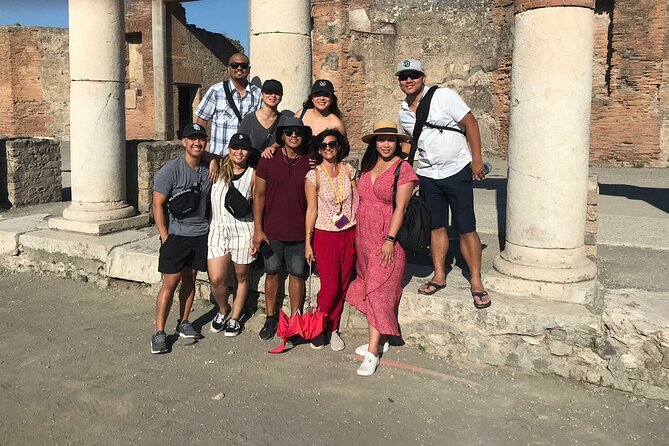
The meeting point is Hotel Vittoria, at Piazza Esedra in Pompeii, near the archaeological site entrance. Make your own way there. From Naples or Sorrento, the Circumvesuviana train to Pompei Scavi station is described as an easy option; check your route and timing before setting out.
Arrive on time and keep your phone number, including country code, on your booking. The operator requests it in case of an emergency. If you are late or miss the tour, there is no refund, so leave a little room for train delays and finding the meeting point.
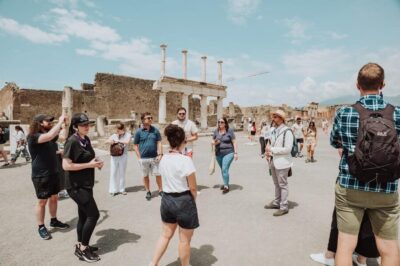
Once the group is together, your guide leads you into the excavations. The group limit of 16 is useful here: Pompeii’s streets and rooms can feel crowded, and a smaller party makes it easier to hear the explanation and ask a question without turning the walk into a lecture hall.
The booking information calls this skip-the-line, and admission is included. Still, read the ticket detail carefully: your confirmation is a guided-tour confirmation, and you can use it only with the guide. It is not a standalone entrance ticket for a separate visit.
More Pompeii visits near Pompeii:
- Pompeii: Entry Ticket and Guided Tour with an Archaeologist
★ 4.8 · 19,459 reviews - Pompeii: Entry Ticket with Optional Audio Guide
★ 4.2 · 12,360 reviews - Pompeii: Small Group Tour with an Archaeologist
★ 4.8 · 12,264 reviews
Reading the streets and wheel ruts
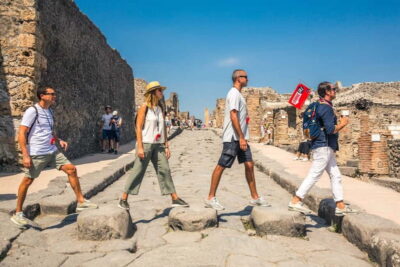
The first lesson is how to look. Pompeii is not just a collection of broken walls; its streets, thresholds, shops, and public spaces show how a Roman city worked. The guide can point out traces that are easy to miss when you are trying to navigate and take in the scale at the same time.
Keep an eye on the original cobblestones. Ruts left by wagon wheels cut into some of the streets, a concrete reminder that this was a working city, not a stage set. The tour notes that you walk on lava rock and ancient paving, so sturdy, comfortable shoes are a practical necessity.
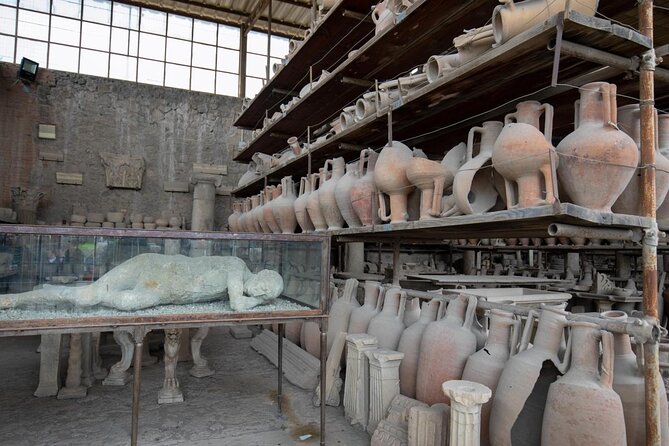
The eruption of Mount Vesuvius in AD 79 is the story that frames the visit. Your guide explains how the eruption buried Pompeii and helped preserve parts of the city. That context matters because the remains are not a tidy museum display. You are walking through a place where daily life was interrupted and then preserved beneath volcanic material.
The forum, where public life met religion
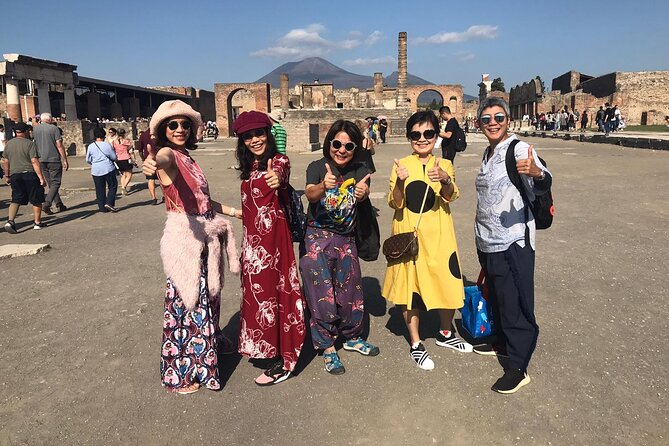
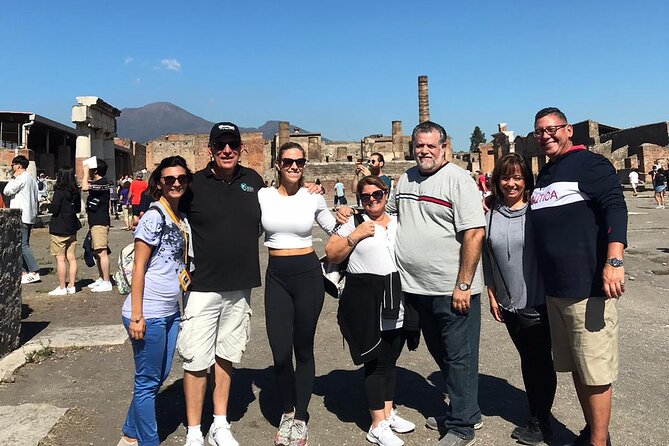
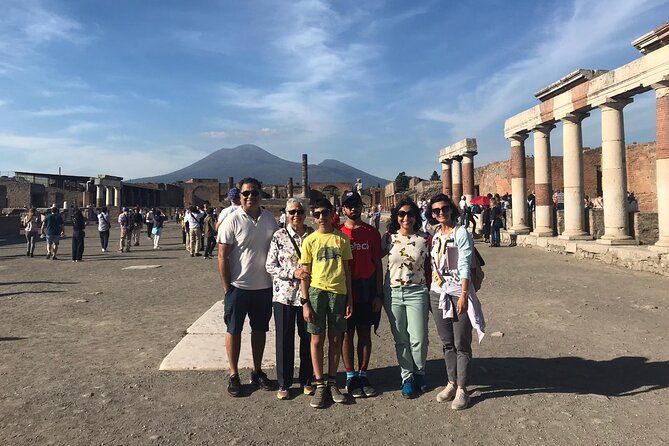
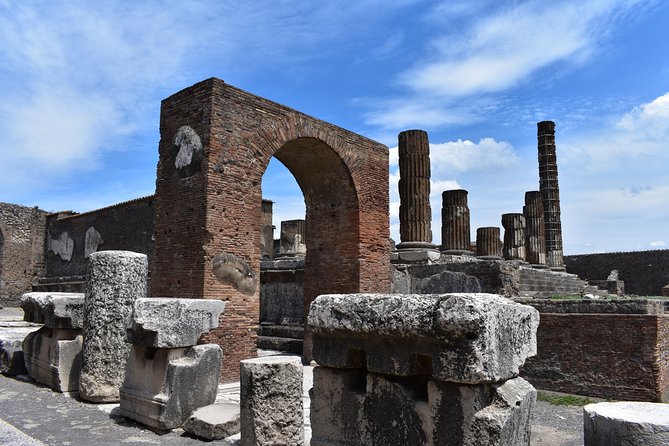
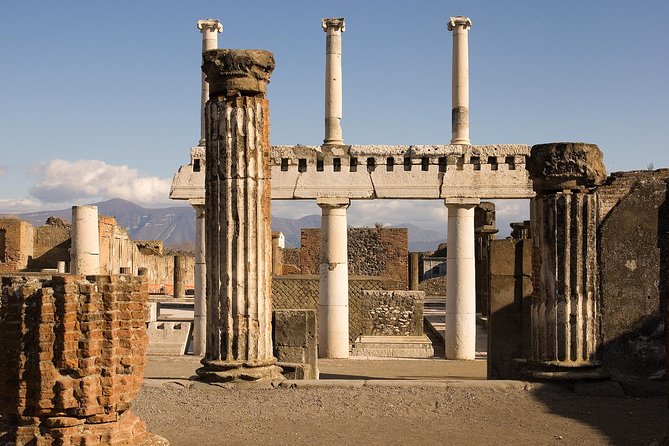
The forum was the city’s civic center, where political and religious life came together. Here, ruins of temples and civic buildings help you picture a public space used by priests, politicians, and residents. A guide can explain what each structure was for and how it fitted into the city, rather than leaving you to guess from columns and foundations.
This is one of the strongest reasons to take a guided tour. Without context, a large open space can look like little more than a plaza with scattered stone. With a clear explanation, you can begin to understand why the forum mattered and how public life shaped the city.
The forum is also a good place to ask questions. Guides including Italo have been praised for welcoming questions from adults and children alike, and for keeping the route moving while still making room for conversation. That balance is valuable: Pompeii is vast, and every stop competes with the next.
Theaters, baths, and the rhythm of a Roman day
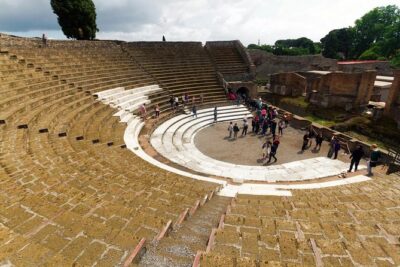
The tour can take you to Pompeii’s theaters, where residents once watched performances of tragedy and comedy. The small theaters are among the stated highlights, and they offer a different view of the city from its temples and public offices. Here, the focus shifts from governing and worship to entertainment and shared culture.
The thermal baths show another part of everyday routine. Residents went there to bathe, exercise, and gossip. The remains give you a sense of how bathing was part of social life, not simply a quick private task. Your guide can help you distinguish the different spaces and explain how the complex served its users.
The gymnasium adds another layer to that picture. These sites can be visited as part of the route, along with the House of Menander. The exact sequence can vary, so treat the tour as a guided selection of highlights rather than a fixed checklist that guarantees every room or street.
More skip-the-line tickets near Pompeii:
- From Naples: Pompeii Skip-the-Line Entry Ticket and Tour
★ 4.4 · 2,753 reviews - Pompeii: Skip-the-Line Entrance Ticket with Audio Guide
★ 4.0 · 2,509 reviews - Pompeii: Archaeological Park Tour with Ticket on request
★ 4.5 · 2,283 reviews - Pompeii: Guided Walking Tour with Entrance Ticket
★ 4.3 · 1,423 reviews
Shops, food counters, and the Lupanare
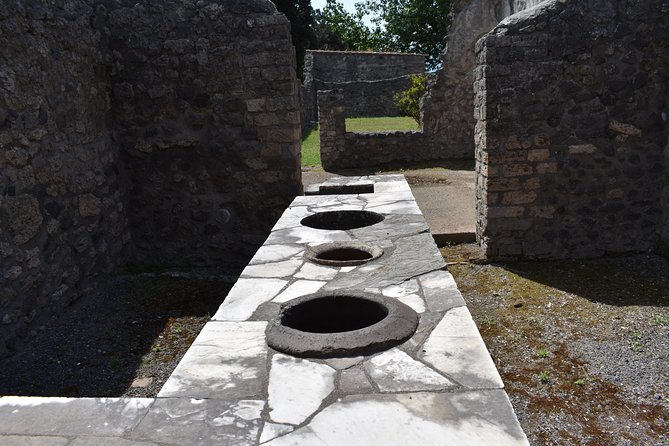
Pompeii’s shops and food businesses are among the most approachable stops because they bring the ancient city down to street level. You may see the remains of bars, restaurants, and shops that sold food and clothing. These ordinary commercial spaces help make the city feel lived in, not merely monumental.
The Lupanare, often called the brothel, is another prominent stop. The tour includes a visit to the rebuilt brothel, one of Pompeii’s best-known attractions. It is a vivid, sometimes provocative part of the site, but it also fits into the larger picture of how people lived and worked in the city.
A guide’s interpretation matters especially here. Without explanation, it is easy to reduce the stop to a curiosity. The better approach is to listen for how the building fits into Pompeii’s social and commercial life, and to ask questions if you want more context.
Gladiators and the House of Menander
The tour can also visit the barracks where gladiators trained and lived. It is a chance to look beyond the familiar image of the arena and consider the preparation and daily routine behind public spectacles. The remains are part of a broader route that moves between civic life, private homes, work, recreation, and performance.
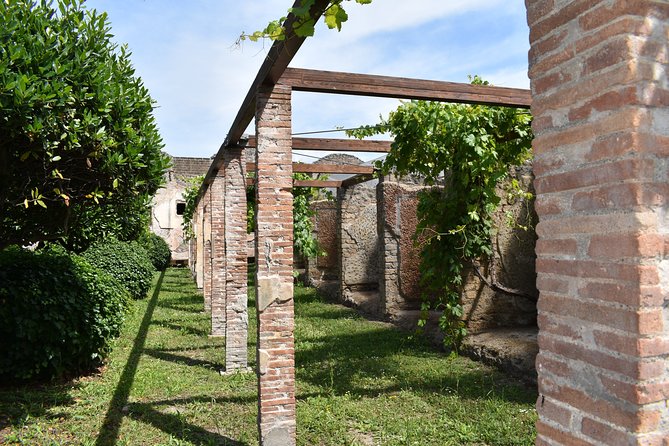
The House of Menander is another named highlight. Pompeii’s homes can be harder to read than its public buildings, since you need to imagine rooms, courtyards, and domestic routines from what survives. A guide helps turn the architecture into a story about how people used their living space.
The route includes many highlights, but the archaeological park is much larger than a two-hour walk can cover. If you want to see more after the tour, ask your guide what to prioritize. Guides such as Italo and Lello have been praised for suggesting additional areas to visit, which can help you use your remaining time well.
Why the guide is the main value
At $71.35 per person, this is not simply an entrance ticket with a short introduction. The price includes admission and a guided walk led by a local guide, with the emphasis on making the ruins legible. That can be good value if you want a strong orientation and do not want to spend your first hours wondering what each building was.
The guide is the biggest variable in the experience, and the names that come up include Lello, Italo, Cela, and Leonardo. Your assigned guide may be someone else. The strongest guides described in the tour details combine archaeological experience with lively storytelling, answer questions, and point out features an unaccompanied visitor might overlook.
Some guides have worked on archaeological digs at Pompeii, and one guide, Lello, is described as having spent years working at the site. That kind of experience can add useful detail about excavation and ongoing work. It also helps explain why participants often find the two hours pass quickly: the guide is not just naming buildings, but giving each stop a purpose.
The group cap of 16 supports that personal feel, though it does not make this a private tour. You will share the guide with other people. If you want time for long, specialized discussions at every stop, a private guide may suit you better. If you want a compact, expert-led overview, this group size is a sensible middle ground.
Timing, comfort, and what is not included
Plan for a full two hours of walking. The tour stays within the archaeological park, and you return to the meeting point at the end. Food and hotel or port pickup and drop-off are not included, so arrange those separately.
Wear shoes that can handle uneven ancient paving and lava rock. In summer, bring a hat: much of the visit is outdoors, and the tour information specifically recommends protection from the sun. A bottle of water may also be a sensible choice, although drinks are not listed as included.
The 5 pm tour also lasts two hours. This gives you a later start, but the information provided does not promise a particular route or crowd level for that time. Whatever departure you choose, the main practical advice is simple: arrive promptly, dress for walking, and do not expect to cover all of Pompeii.
The booking has free cancellation up to 24 hours before the start time. A cancellation inside that window is not refundable, and changes made less than 24 hours before are not accepted. The experience can also be canceled for poor weather or if the minimum group size is not met; in those cases, you are offered another date or a full refund.
Is this Pompeii tour worth booking?
I would choose this tour if you have limited time, want the main sights explained, or are worried that Pompeii’s scale will leave you wandering without a sense of what matters. The combination of an archaeologist guide, admission, and a group capped at 16 makes the $71.35 price easier to justify than paying for entry alone and trying to piece the site together yourself.
It is especially suited to families and first-time visitors who want a lively introduction. If you already know Pompeii well, prefer to move at your own pace, or plan to spend a full day exploring every district, a two-hour group walk may feel too brief. For many visitors, though, it is a useful start: take the guided route, then stay on to explore more on your own if time allows.
FAQ
How long is the Pompeii tour?
The tour lasts approximately two hours. The 5 pm departure also lasts two hours.
What is the price?
The listed price is $71.35 per person. Group discounts are available.
Is admission to Pompeii included?
Yes, admission tickets are included. The confirmation is for the guided tour and can be used only with the guide, not as an independent ticket to the ruins.
Where does the tour meet?
The meeting point is Hotel Vittoria, Piazza Esedra, 80045 Pompei, Italy. The activity ends back at the meeting point.
How do I get to the meeting point?
You make your own way there. The Circumvesuviana train from Naples or Sorrento to Pompei Scavi station is described as an easy option.
How large is the group?
The tour has a maximum of 16 travelers.
What should I wear?
Wear comfortable shoes because you will walk on original ancient streets and lava rock. A hat is recommended for summer sun.
Is food or hotel pickup included?
No. Food and hotel or port pickup and drop-off are not included.
Can I cancel for a refund?
You can cancel at least 24 hours before the experience’s start time for a full refund. Cancellations made less than 24 hours before the start time are not refunded.
Recently added near Pompeii
- Capri Tour from Pompeii, Vico Equense & Castellammare di Stabia★ 4.5 · 57 reviews
- Capri, Sorrento and Pompeii Private Tour★ 5.0 · 3 reviews
- Capri, Blue Grotto, Sorrento & Pompeii Private Tour★ 5.0 · 12 reviews
- Day Trip to Capri, Blue Grotto, Sorrento & Pompeii Entry Tickets★ 5.0 · 12 reviews
- Day Trip to Capri, Sorrento and Pompeii from Rome★ 5.0 · 6 reviews
- 3-Days Audio Guide for Pompeii, Herculaneum, Vesuvius and Naples★ 5.0 · 7 reviews
- Minivan Tour | Amalfi Ravello and Pompeii with driver★ 4.5 · 11 reviews
- Amalfi, Ravello & Pompeii: private tour with no-traffic (8-hour)★ 5.0 · 4 reviews
Pompeii Tours, compared.
Pompeii: Entry Ticket and Guided Tour with an Archaeologist
Read our review →
Pompeii: Entry Ticket with Optional Audio Guide
Read our review →
Pompeii: Small Group Tour with an Archaeologist
Read our review →
Naples or Sorrento: Full-Day Pompeii and Mount Vesuvius Tour
Read our review →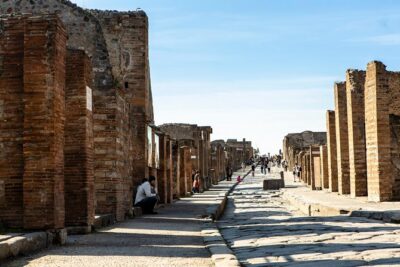
Pompeii & Mt.Vesuvius Day Tour from Naples with Pizza Lunch
Read our review →
Pompeii & Mt Vesuvius All-Inclusive Small Group w/ Lunch
Read our review →Browse the lists this tour appears in