
Reviewed · POMPEII TOURS
Pompeii: Small Group Tour with an Archaeologist
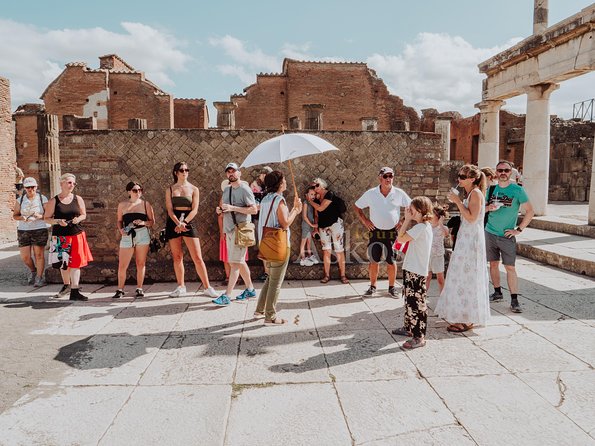
Pompeii is a city best understood on foot, but its streets can seem like a maze of stone until someone shows you what to look for. An archaeologist guide connects the Forum, homes, baths, and shops to the daily lives that ended when Vesuvius erupted in 79 AD.
I like two things in particular: the tour gives you a clear route through major sights, and your guide can point out details that are easy to miss, from cart tracks to the features that distinguish a shop from a home. You also get time to continue exploring after the guided portion.
One consideration: two hours is an introduction, not a complete visit. Pompeii is vast, the ground is uneven, and the route may change with crowds or closures. If you want to see the Villa of the Mysteries with a guide, choose the three-hour option.
- Start with the Forum: See the civic center, temples, Basilica, and Vesuvius in one strong orientation to the city.
- Look beyond the big ruins: Your guide can help you notice shop entrances, street details, mosaics, and frescoes.
- Choose your pace: Book a shared small-group tour or a private tour; the longer option includes the Villa of the Mysteries.
- Stay after the tour: Use your guide’s suggestions to plan more time inside the archaeological site.
- Plan for uneven ground: Steps, ramps, slopes, and long distances make this a poor fit for wheelchair users and people with mobility impairments.
Pompeii Makes More Sense With a Guide
The scale of Pompeii is part of its wonder and part of its challenge. It is not a compact set of ruins you can understand in a quick loop. Streets run between public buildings, shops, baths, theaters, and private homes, and a first-time visitor can easily walk past a small clue that explains how a place was used.
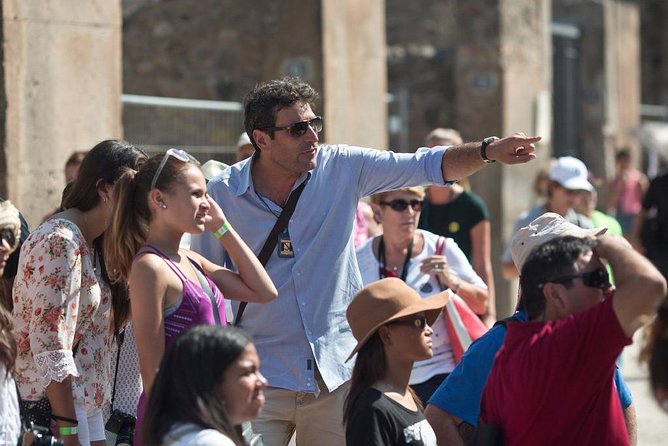
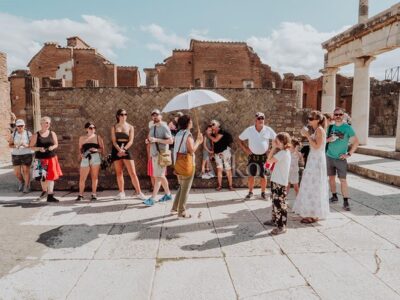
An archaeologist gives you a way into that everyday world. Rather than seeing only old walls, you can learn how public life centered on the Forum, how people moved through the streets, and what details in a doorway might tell you about the building behind it. Guides also use stories and anecdotes to make the city’s residents feel less remote.
The tour’s strength is not simply that it takes you to famous places. It gives those places a thread. When the guide explains what you are looking at, you can spend the rest of your visit noticing more for yourself.
Past guides have included Roxanne, Alessandra, Paolo, Mario, Teresa, and Nicoletta. The names are not a guarantee of who will lead your tour, but they give a sense of the range of archaeologists working here. Strong guides are often described as clear, engaging storytellers who welcome questions and make the history enjoyable for adults and children alike.
Enter Through Porta Marina and Find Your Bearings

The tour begins at one of several possible meeting points, depending on the option you book. Check the exact location and arrive with time to spare. A few people have had trouble with check-in or locating their group, so it is sensible to confirm that your name has been marked off before the tour starts.
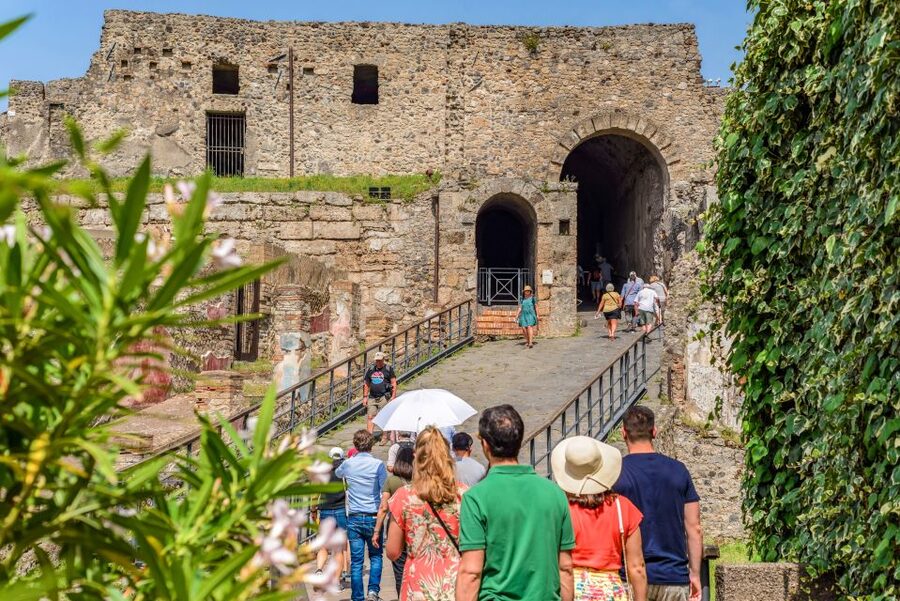
At Porta Marina Superiore, one of the ancient city’s seven gates, your guide brings you into the archaeological site. This entrance sets the scene for a city whose remains were preserved under volcanic material after the eruption of Mount Vesuvius in 79 AD.
The Pompei Express entry ticket is included, and the experience is listed as skip-the-ticket-line. That saves you from arranging a separate admission ticket, though it does not remove the need to find your meeting point or follow the group’s check-in instructions.
The landscape beneath your feet matters here. Pompeii has steps, ramps, uneven paving, and some inclines, so comfortable walking shoes are a practical choice. The tour is not recommended for people with mobility impairments and is not suitable for wheelchair users.
More Pompeii visits near Pompei Campania:
- Pompeii: Entry Ticket and Guided Tour with an Archaeologist
★ 4.8 · 19,459 reviews - Pompeii: Skip-the-Line Entrance Ticket with Audio Guide
★ 4.0 · 2,509 reviews - Naples: Pompeii and Mt. Vesuvius with Lunch and Wine Tasting
★ 4.5 · 2,454 reviews
The Forum, Temples, and Vesuvius
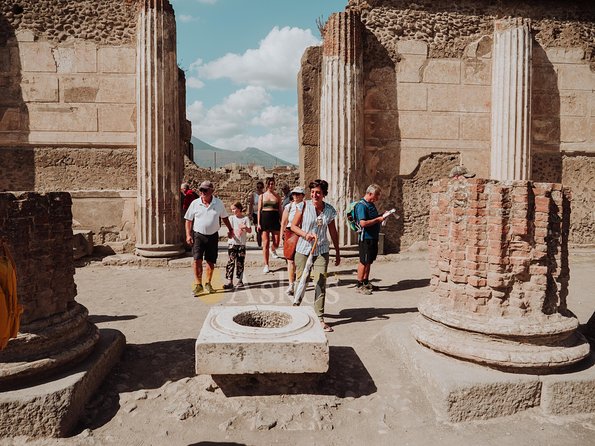
The Forum was the city’s public heart, and it is one of the best places to start building a mental map. From here, you can see Vesuvius beyond the ruins, a striking reminder of the force that changed Pompeii’s history.
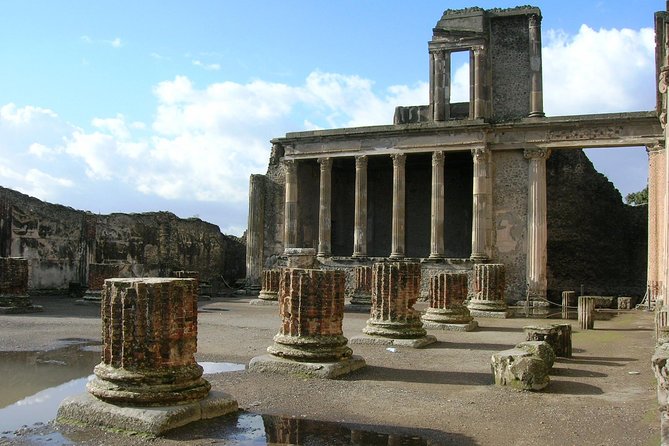
Nearby stops include the Temple of Apollo, the Temple of Jupiter, and the Basilica. The Basilica was a center for business and legal matters, not a church in the modern sense. With a guide, you can begin to separate religious spaces from civic ones and understand how much public life gathered around this central area.
This is also where a two-hour tour earns its keep. A guide can give you a broad framework early on, so later streets and buildings feel connected instead of like a long succession of stone facades. The trade-off is that the route has to keep moving. You may want to linger, but the group has more ground to cover.
Crowds and temporary closures can change the route. Guides may adjust the order of stops to avoid busy areas or accommodate what is open. That flexibility can make the walk more pleasant, but it means you should treat the named sights as a planned selection rather than a promise that every stop will be visited in the same order.
Shops, Homes, and the Small Clues

Pompeii’s houses help reveal how the wealthy lived, while its commercial spaces give the streets a practical, everyday dimension. The tour includes the House of Menander and the House of the Faun, along with the House of the Vettii. Each offers a different chance to look at domestic architecture and surviving decoration.
The House of the Vettii is especially appealing if you want to see preserved art in its original setting. Frescoes and other details are easier to appreciate when someone explains what you are seeing and where to focus. Your guide may also point out small clues in doorways or entrances that help identify a shop or residence.
Mosaics, frescoes, and other artworks are among Pompeii’s most memorable features. They are not just decoration to glance at before moving on. Look closely at how images, surfaces, and room layouts relate to one another, and the houses begin to feel less like empty shells.
The itinerary also includes the bakery. A stop like this adds useful contrast to the larger residences and civic buildings: it reminds you that Pompeii was a working city, not only a collection of grand houses. Ask questions as you go. Guides are there to explain details, and the most valuable discoveries may come from a feature you would otherwise have passed without noticing.
Baths, the Lupanar, and the Plaster Casts
The Forum Baths provide a look at another part of Roman public life. Together with temples, theaters, and civic spaces, they help show how much of the city’s daily routine took place outside the home.
The Lupanar, Pompeii’s famous brothel, is one of the tour’s most talked-about stops. The guide explains its name and the significance of its stone beds and preserved frescoes. Some locations and graffiti touch on adult themes, so this part of the walk may suit your family less well if you would rather avoid that subject. Guides can frame the material in context, and one family found that their 10-year-old was mostly unaware of it, but each child is different.
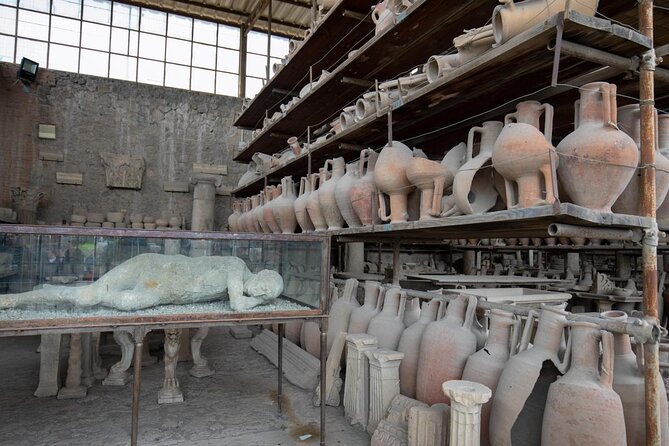
The plaster casts offer a sobering reminder of the eruption and the people caught in it. Their display can change: three casts have been noted in sealed glass cases, rather than casts placed throughout individual dwellings. If seeing them is important to you, ask your guide what is currently accessible. It is worth approaching this stop with care; the casts are not simply another photo opportunity, but a human link to the catastrophe.
More small-group tours near Pompei Campania:
- Pompeii: Small-Group Tour of Pompeii and Herculaneum
★ 4.8 · 867 reviews - Pompeii: Small Group Guided Tour and Skip-the-Line Ticket
★ 4.5 · 91 reviews - From Positano: Pompeii Ruins Small Group Guided Tour
★ 4.8 · 82 reviews - Pompeii Small Group Tour – Tickets Included
★ 4.7 · 72 reviews
The Great Theater and the Three-Hour Choice
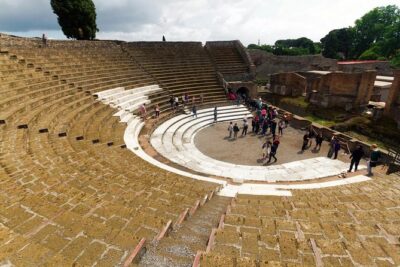
The Great Theater gives the tour another major public space to interpret. You can stand among the remains and consider the role of performance and gathering in city life. For many visitors, walking into the theater is a memorable moment, but it is one part of a much larger site.
The two-hour option works well if you want an expert introduction and plan to explore independently afterward. It covers many of the principal sights, but it cannot show you everything. The three-hour option adds the Villa of the Mysteries, known for its remarkable frescoes. If art is a major reason for your visit, that extra hour is a meaningful upgrade.
At the Villa, your guide can help you look closely at the frescoes and explain their details. The longer tour is also a better fit if you prefer to move at a more measured pace or want more time for questions. Still, do not mistake three hours for a full tour of Pompeii. The site is large enough that even a well-planned guided walk leaves plenty for later.
Make the Extra Time Count

After the official tour, you are free to stay inside the archaeological site and continue on your own. This is one of the tour’s most useful features. The guided walk gives you a framework; the remaining time lets you revisit a favorite house, take a slower look at a mosaic, or follow your guide’s suggestions.
Guides often offer practical ideas for what to see next. Take note of them before the tour ends, especially if you have a short visit or need to leave by a set time. Pompeii’s scale can catch people off guard. One visitor estimated that walking from one side of the site to the other takes about half an hour, and many areas cannot be covered in a day.
Tour timing matters for that reason. If you want a long independent visit afterward, an earlier start gives you more usable time. A late-afternoon tour may leave less room to roam, particularly if parts of the site are closing. Check the site’s current hours when planning your day rather than assuming you will have plenty of time after the guide finishes.
Price, Group Format, and Practical Details
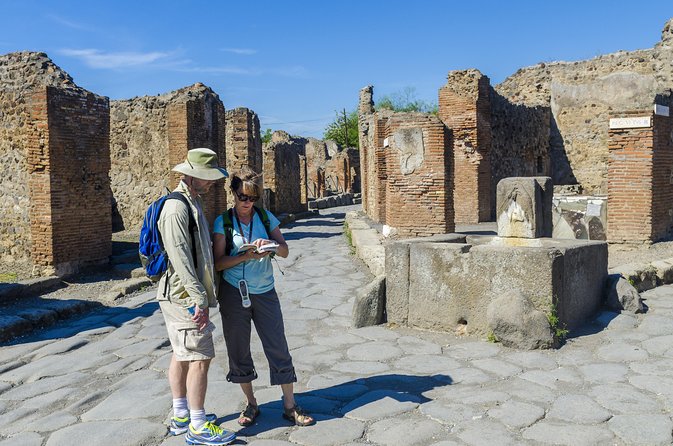
At $40 per person, the tour combines entry with two or three hours of an archaeologist’s time. For a first visit, that can be good value: your guide helps you make sense of the site, points out features that are easy to overlook, and gives you a plan for what to see next. The entry ticket is included, while food, drinks, transportation, and personal expenses are not.
You can choose a shared small-group tour or a private experience. A private tour gives your party the guide’s attention; a shared group can be a less expensive way to get expert context. Exact group size is not specified, so do not book on the assumption that the group will have a particular number of people.
Headsets are available for groups of 16 or more. Shared and private options may not offer the same languages, so check that your preferred language is available for the tour format you want. English, French, Spanish, German, Portuguese, and Italian are among the listed languages.
Bring a passport or ID card; a copy is accepted. Large bags and luggage are not allowed, and smoking and mobility scooters are prohibited. A free cloakroom is next to the Porta Marina Superiore entrance, subject to availability. Dogs over 10 kilograms are not allowed at the site, and children must be accompanied by an adult.
Who Should Book This Pompeii Tour?
I would choose this tour if it is your first time in Pompeii and you want more than a walk through ruins with a map. It is especially useful if you enjoy learning from an archaeologist, want help spotting details, or are short on time and need a sensible route through the main sights.
Families with children can also benefit from a guide who can keep the story lively and answer questions. The Lupanar includes adult subject matter, so consider your child’s age and interest before booking. If you want the Villa of the Mysteries, choose the three-hour option; if you would rather leave room for your own exploration, the two-hour tour is a practical starting point.
Skip it if you need step-free access or cannot manage uneven ground and inclines. Also think twice about a late start if you want to see a large part of Pompeii afterward. For most first-time visitors who can comfortably walk the route, this is a useful way to turn an immense archaeological site into a city you can begin to understand.
FAQ
How long is the tour?
Choose a two-hour tour or a three-hour tour. The three-hour option includes a visit to the Villa of the Mysteries.
Is Pompeii entry included?
Yes. The tour includes a Pompei Express entry ticket, and the activity is listed as skip-the-ticket-line.
Can I book a private tour?
Yes. You can choose between a shared small-group tour and a private group experience.
What languages are available?
The listed languages are English, French, Spanish, German, Portuguese, and Italian. Language options may differ between shared and private tours, so check the option you plan to book.
Can I stay in Pompeii after the tour?
Yes. You are free to remain inside the archaeological site and explore on your own after the guided tour.
Does the three-hour tour visit the Villa of the Mysteries?
Yes. The three-hour option includes a visit to the Villa of the Mysteries.
Is the tour suitable for wheelchair users?
No. It is not suitable for wheelchair users and is not recommended for people with mobility impairments because of steps, ramps, slopes, and a short steep climb.
What should I bring?
Bring a passport or ID card. A copy is accepted.
Are large bags allowed?
No. Luggage and large bags are not allowed. A free cloakroom is located next to the Porta Marina Superiore entrance, subject to availability.
Recently added near Pompei Campania
- Pompeii and Vesuvius Cellars: Tour with Pick-Up in Positano★ 4.7 · 3 reviews
- From Sorrento: Pompeii with an Archaeological Guide & Ticket★ 4.6 · 19 reviews
- From Positano: Pompeii Ruins Small Group Guided Tour★ 4.8 · 82 reviews
- From Naples: Pompeii Wheelchair-accessible with a Guide★ 5.0 · 8 reviews
- Pompeii Positano Amalfi Day Trip from Rome by Car, No Bus!★ 5.0 · 5 reviews
- Pompeii & Virtual Museum Private 2-in-1 Kid’s Tour★ 4.9 · 9 reviews
- Pompeii & Vesuvius★ 4.3 · 12 reviews
- Pompeii Tour_Skip the line ticket + audioguide★ 4.7 · 17 reviews
Pompeii Tours, compared.
Pompeii: Entry Ticket and Guided Tour with an Archaeologist
Read our review →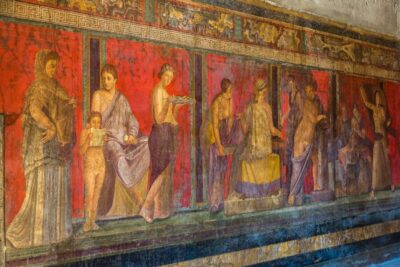
Pompeii: Entry Ticket with Optional Audio Guide
Read our review →
Pompeii Small Group Tour with an Archaeologist
Read our review →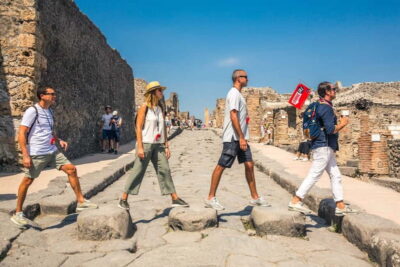
Naples or Sorrento: Full-Day Pompeii and Mount Vesuvius Tour
Read our review →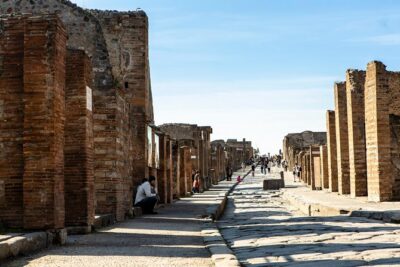
Pompeii & Mt.Vesuvius Day Tour from Naples with Pizza Lunch
Read our review →
Pompeii & Mt Vesuvius All-Inclusive Small Group w/ Lunch
Read our review →Browse the lists this tour appears in