
Reviewed · POMPEII TOURS
Pompeii: Private Tour with an Archaeologist
Pompeii is not just a collection of ruins. Its streets, shops, baths, and houses preserve the shape of a Roman town interrupted by the eruption of Vesuvius in 79 A.D. With a private archaeologist-guide, you can connect the stones to the daily routines that once filled them.
I like two things in particular: the chance to ask questions and set a more personal pace, and a route that takes in major public buildings as well as homes and shops. Guides named in past tour accounts include Nicoletta, Patrizia, Jasmine, and Diego, among others.
The trade-off is the price: $508.15 for a private group listed as up to one person is a substantial outlay, especially for a solo visitor. Three hours also gives you a strong introduction, not time to see every corner of Pompeii.
Key points to know before you book
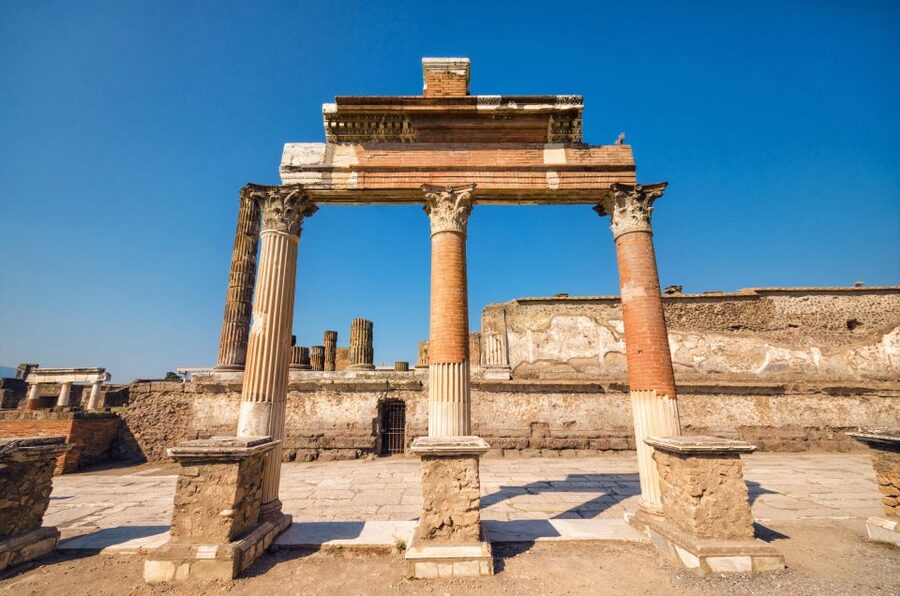
- Three hours among Pompeii’s main sights: The route includes the Forum, major temples, baths, houses, the brothel, theaters, and amphitheater.
- Private means room for questions: You can ask about what you see and, according to past accounts, guides can adapt the visit to your interests and the crowds.
- A certified archaeologist-guide is included: The tour is designed to explain the site’s history and archaeology, not just lead you from one landmark to another.
- Skip-the-line admission is included: You do not need to arrange separate entry for the standard visit.
- Meet at Porta Marina Superiore: Find the guide in front of Hortus, the bar-restaurant with lemons and oranges hanging outside.
- Check the accessibility details directly: The tour information both describes the activity as wheelchair accessible and says it is not suitable for wheelchair users.
Start at Porta Marina, where Pompeii’s scale becomes clear
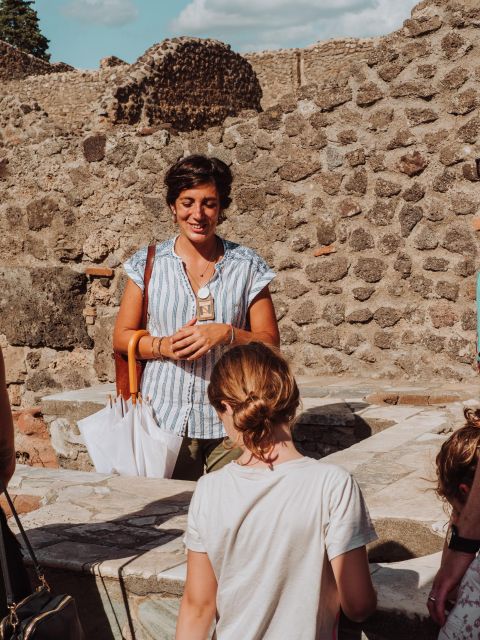
Meet at Porta Marina Superiore, the main gate specified for the tour, in front of Hortus. The activity ends back at the meeting point, so plan your onward transport from there. Transport to Pompeii is not included.
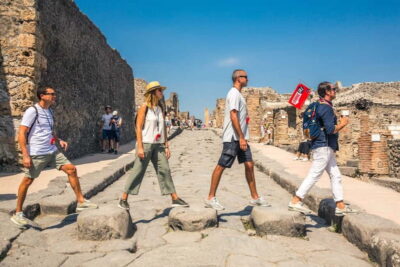
Porta Marina was one of the city’s principal entrances. Starting here gives your guide a natural place to explain how people entered Pompeii and how its streets connected the public center with the rest of town. The route then moves through a dense sequence of significant sites, so comfortable shoes matter.
A three-hour walk can feel full. Pompeii is a large archaeological site, and its broad paved streets and scattered buildings require steady walking. The value of a guide is not only getting from one stop to the next, but learning what to notice along the way: a threshold, a shopfront, a public monument, or the remains of a house.
More Pompeii visits near Naples:
- From Naples: Pompeii Ruins & Mount Vesuvius Day Tour
★ 4.3 · 11,459 reviews - Naples or Sorrento: Full-Day Pompeii and Mount Vesuvius Tour
★ 4.6 · 4,235 reviews - Pompeii & Mt.Vesuvius Day Tour from Naples with Pizza Lunch
★ 4.0 · 2,901 reviews
Temples, the Forum, and the machinery of city life
At Porta Marina, the tour begins its walk through the ancient city. The Temple of Apollo follows, one of the stops that helps introduce Pompeii’s religious life and the importance of civic spaces. Your guide can give context that makes the buildings easier to read, though the experience is still an outdoor walk among archaeological remains rather than a visit to an intact temple.
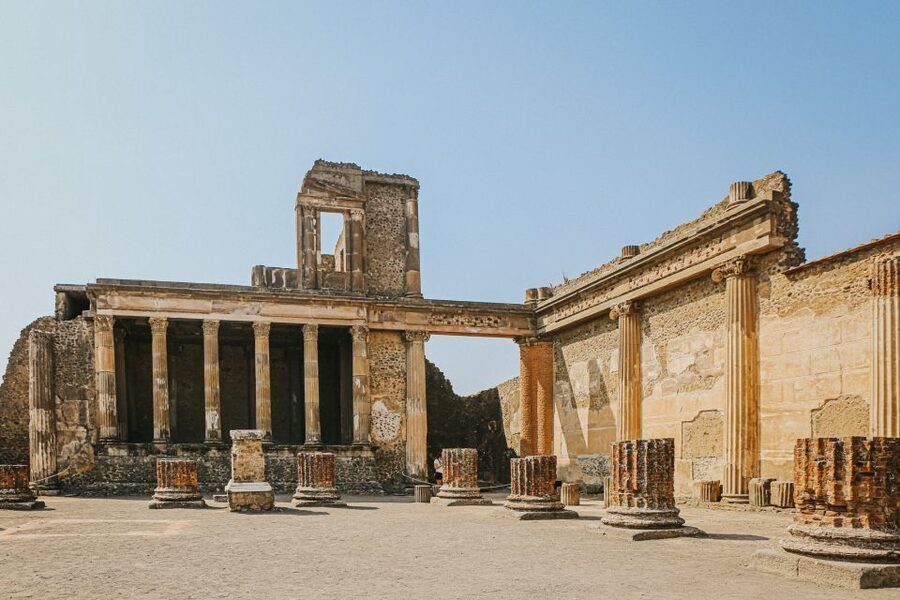
The Forum is the route’s central public stop. In Roman towns, a forum was a place for public business and civic life, and Pompeii’s main square helps you grasp how the city was organized. The nearby Temple of Jupiter and Basilica add to that picture. The Basilica was a public building, while the temple marked the religious character of the center.
These sites are especially useful early in the tour because they give you a map in your mind. Once you understand where public life gathered, the houses, baths, and shops feel less like isolated ruins and more like parts of a working town. You can ask your guide how the buildings served the community and how archaeologists interpret what remains.
Houses, baths, and the details of daily routines
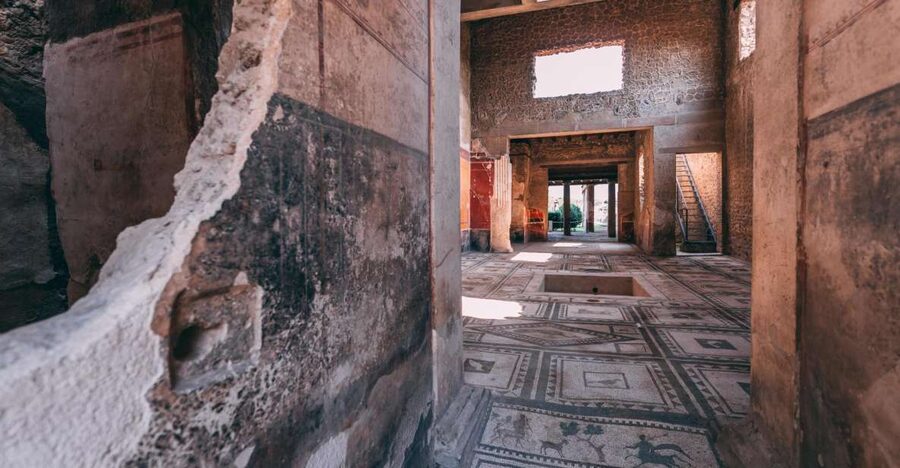
The House of Menander offers a change of scale. Instead of looking at a public square, you step into the remains of a private home. The tour also includes the House of the Faun and the House of the Vettii, giving you several chances to consider how domestic spaces were arranged and what they suggest about life in Pompeii.
A private guide can help you look beyond the size or decoration of a house. Past accounts particularly praise guides who point out small details and explain how people lived, rather than simply naming each building. Nicoletta, for example, was praised for combining close observation with human stories and a sense of humor. That kind of interpretation can make a house feel less like a floor plan and more like a place where people once ate, worked, and entertained.
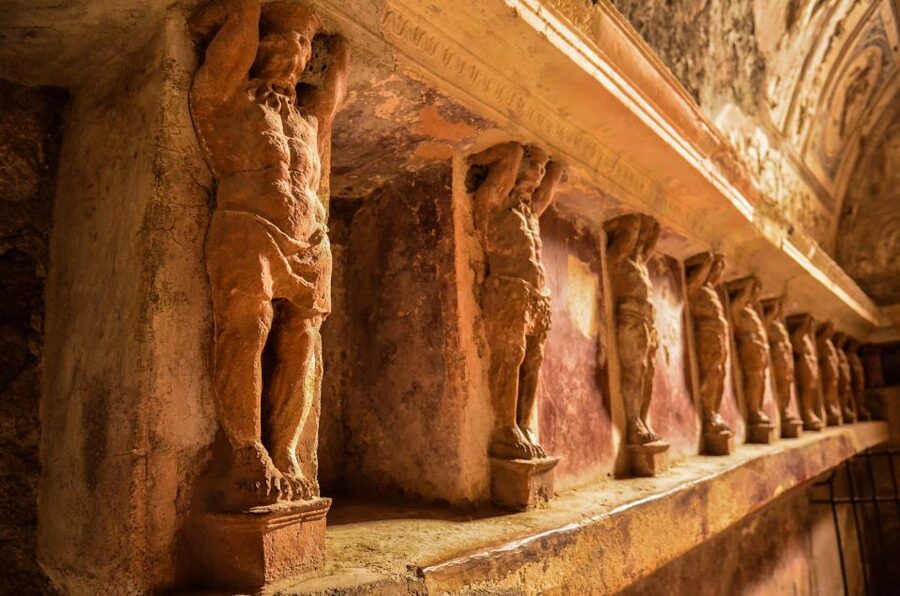
The Forum Baths add another angle on daily life. Public bathing was part of Roman social routine, and the remains help you imagine how people used shared spaces. The Stabian Baths are also named among the tour’s highlights, though they are not listed as a separate stop in the timed route. Ask your guide which bath complex the route visits and how much time is available there.
The Lupanare, shops, and less formal corners of Pompeii
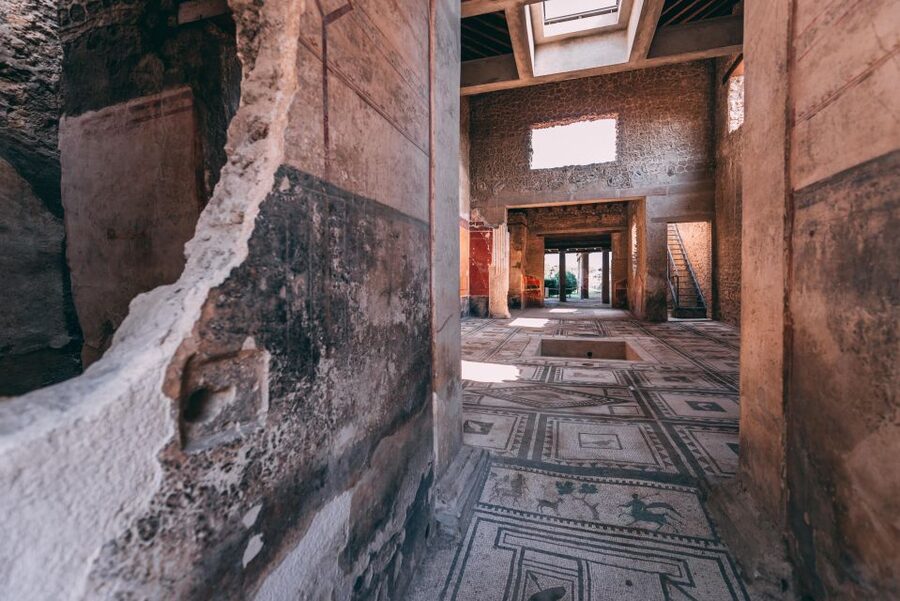
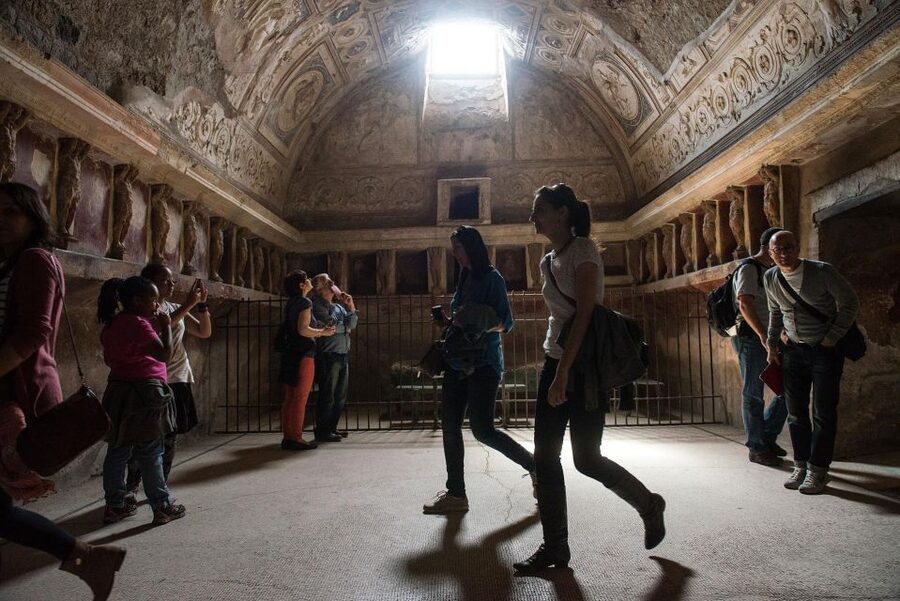
The Lupanare, commonly known as the brothel, is one of the route’s most distinctive stops. Its place in the city offers a chance to discuss an aspect of Roman life that can be reduced to a novelty if you rush through. A guide can provide context and answer questions, which is useful here as much as at the temples or Forum.
The tour also includes shops and fountains. These smaller features matter because they show how ordinary needs shaped the streets. A fountain was part of the city’s water access, while shops put commerce right along the routes people used every day. They may be brief stops rather than major set pieces, but they help fill in the picture of a functioning town.
Pompeii’s plaster casts of victims are another important highlight. They bring the eruption’s human cost close, and the subject deserves a measured approach. A guide can explain what the casts represent and how the preservation process works. Paola, one of the guides named in past accounts, was noted for explaining the volcano, eruption, excavation, and preservation together, a useful combination for understanding both the disaster and the archaeological site you are walking through.
More private tours near Naples:
- Exclusive Naples Private Food Tour: 6 or 10 Tastings
★ 5.0 · 596 reviews - Private Day Tour: Sorrento, Positano, Amalfi, Ravello from Naples
★ 4.5 · 546 reviews - Private Day tour of Positano, Amalfi and Ravello from Naples
★ 5.0 · 522 reviews - Private Amalfi Coast Tour – Enjoy it with our local english speaking driver
★ 5.0 · 475 reviews
Theaters and amphitheater: public life on a larger scale
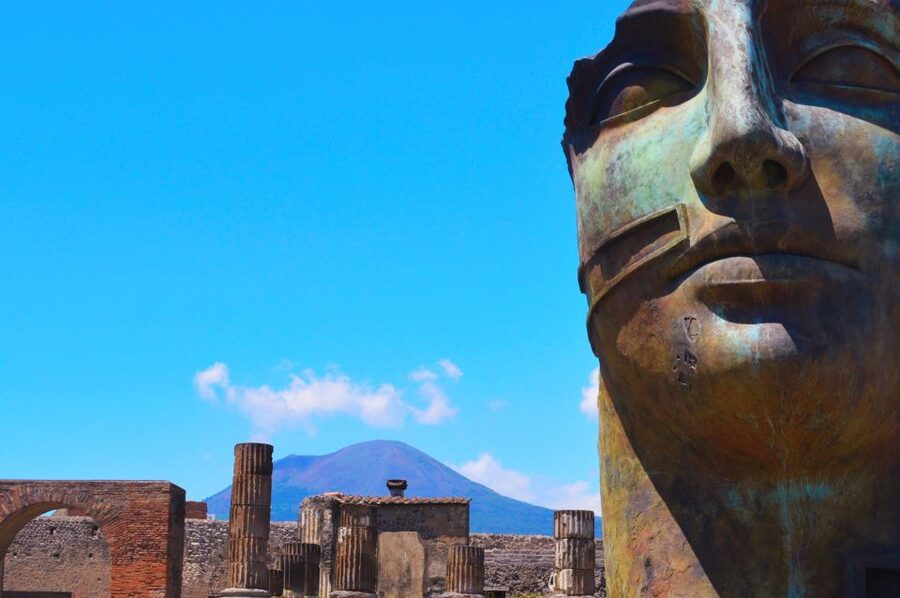
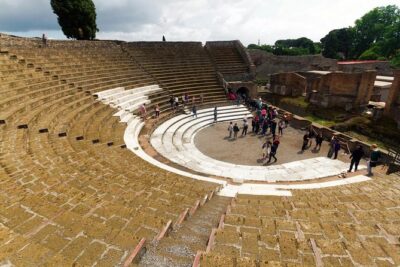
The Large Theatre gives the route another public setting. The theaters show that Pompeii was not only a place of work, worship, and household life; performance and shared entertainment were part of the city too. Your guide can help you see the layout and explain what the remains tell us, though the tour’s three-hour limit means this is a guided visit rather than a long, independent exploration.
The Amphitheater of Pompeii is the final named stop before the route returns to the meeting area. It gives you a sense of the scale of public gatherings in the ancient city. The route covers a remarkable range, from the Forum and temples to houses, baths, theaters, and the amphitheater, but it cannot show every street or building in depth.
That is where the private format earns its keep. Several guides named in past accounts, including Laura and Mena, were described as adapting the visit to interests, questions, and changing crowds. You should not assume a specific guide will be assigned, but the ability to ask questions and move at a pace that suits your group is a real advantage over a fixed, large-group commentary.
What the private format is worth
At $508.15 for a group listed as up to one person, this is a premium experience. The price includes a certified archaeologist-guide and skip-the-line admission, but not transport, food, drinks, or personal expenses. For a solo visitor, the stated price is hard to justify if your main goal is simply to enter Pompeii and walk around.
The calculation changes if you are traveling with others and the price is shared, though the advertised group limit should be checked carefully before booking. A private tour can be good value if you want a focused introduction, have a strong interest in archaeology, or prefer to ask questions without competing for a guide’s attention. Families may also appreciate the flexibility: one past account describes a guide keeping children engaged, while another mentions a tour that worked well for 12-year-old twins.
The guide is central to the experience. People named in past accounts include Nicoletta, Patrizia, Jasmine, Silvia, Serenella, Annalisa, Diego, Andrea, Paola, Michele, Monica, Mena, and Antonella. Their names are not a guarantee of who will lead your tour. One account also questioned whether the assigned guide was an archaeologist, so if formal archaeological credentials are important to you, confirm what is meant by certified archaeologist-guide before you pay.
Practical details for a smoother visit
The tour lasts three hours, with starting times shown when you check availability. The meeting point is Porta Marina Superiore, in front of Hortus, identified by the lemons and oranges hanging outside. The tour finishes back at the meeting point.
Comfortable shoes are essential. The visit takes place in any weather, so bring a raincoat if rain is forecast. The information says umbrellas are not allowed, even though its rain advice also mentions a small umbrella; to avoid a problem at entry, follow the restriction and choose a raincoat.
The tour is offered in Japanese, English, Spanish, Italian, German, French, Portuguese, Chinese, and Russian. Disposable earphones are provided for bigger groups, though this is a private tour. Pets are not allowed.
There is conflicting accessibility information: one section calls the activity wheelchair accessible, while another says it is not suitable for wheelchair users. Pompeii’s uneven archaeological setting makes this worth resolving before booking. Contact the provider directly to confirm whether the route and surfaces will work for your needs.
On the first Sunday of each month, entry is free, but tickets cannot be reserved ahead of time and entry is not guaranteed. Since skip-the-line admission is otherwise included, ask the provider how the tour and entry arrangements work on that day rather than assuming the usual setup applies.
Should you book this Pompeii tour?
Book it if you want a guided framework for a very large site, value direct conversation with an archaeologist-guide, and are interested in the everyday details behind the famous ruins. The route covers an impressive range in three hours, and a private format can make it easier to follow your own questions rather than a group’s fixed pace.
Think twice if you are traveling alone and focused on keeping costs down, or if you want a slow, exhaustive visit. The price is high, and this tour is an introduction, not a full day in Pompeii. Before booking, confirm the group price, the guide’s credentials, and the accessibility arrangements. If those details fit your plans, this is a strong way to make the Forum, houses, baths, and theaters add up to a city rather than a string of stones.
FAQ
How long is the tour?
The tour lasts three hours. Starting times depend on availability.
Where does the tour meet?
Meet at Porta Marina Superiore, in front of the bar-restaurant Hortus, the building with lemons and oranges hanging outside.
Where does the tour end?
It ends back at the meeting point.
Is admission included?
Yes. Skip-the-line admission fees are included.
Is transportation included?
No. Transportation, food, drinks, and other personal expenses are not included.
Which languages are available?
The tour is offered in Japanese, English, Spanish, Italian, German, French, Portuguese, Chinese, and Russian.
Can I bring an umbrella?
The information lists umbrellas as not allowed. It also recommends rain protection in wet weather, so bring a raincoat.
Recently added near Naples
- Tiramisù Making Class With Limoncello or Meloncello Tasting★ 5.0 · 17 reviews
- Private Natural Wine Vs Byodinamic and Organic Wine Tour★ 5.0 · 6 reviews
- Caserta Royal Palace tour★ 5.0 · 4 reviews
- Tour in the Charterhouse of St. Martin and Pedamentina with an art expert★ 4.5 · 3 reviews
- Private City Kickstart Tour: Naples★ 5.0 · 7 reviews
- Caserta Royal Palace Private Walking Tour★ 4.5 · 12 reviews
- Caserta Royal Palace small group tour★ 5.0 · 6 reviews
- Caserta Royal Palace Entrance Ticket★ 3.5 · 78 reviews
Pompeii Tours, compared.
Pompeii: Entry Ticket and Guided Tour with an Archaeologist
Read our review →
Pompeii: Entry Ticket with Optional Audio Guide
Read our review →
Pompeii: Small Group Tour with an Archaeologist
Read our review →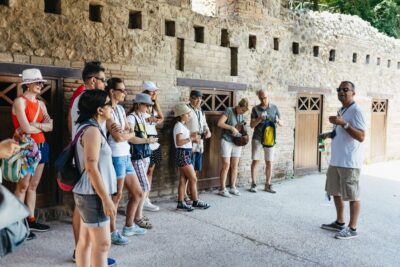
Naples or Sorrento: Full-Day Pompeii and Mount Vesuvius Tour
Read our review →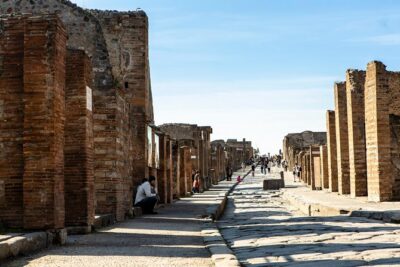
Pompeii & Mt.Vesuvius Day Tour from Naples with Pizza Lunch
Read our review →
Pompeii & Mt Vesuvius All-Inclusive Small Group w/ Lunch
Read our review →Browse the lists this tour appears in