
Reviewed · HERCULANEUM TOURS
From Naples: Pompeii & Herculaneum with Archaeologist Guide
Herculaneum’s carbonized wood and intact paintings make a striking counterpoint to Pompeii’s broad streets and public buildings. In one day, an archaeologist guide helps you read both sites as Roman towns, not just rows of old stones.
I like two things in particular: the side-by-side comparison of towns buried by the same eruption, and the minibus transfer with skip-the-line entry at both sites. Guides on different departures have included Raphael, Roberta, Gennaro, Michele, and Julia.
The trade-off is time. Two hours at each site gives you a guided route through major sights, not a leisurely visit to every house and exhibit. Expect uneven ground, stairs, and a full day on your feet.
- Herculaneum’s preserved details: See carbonized wooden objects, paintings, mosaics, and the beach area where more than 300 skeletons were found.
- Pompeii’s essential sights: Walk from Marina Gate to the Forum, with stops that may include the Basilica, baths, bakery, and plaster casts.
- A guide who puts the ruins in context: The archaeologist-led visits focus on daily Roman life as well as the eruption of 79 AD.
- A small group: The tour is limited to 20 participants, a manageable size for moving through busy archaeological sites.
- Transport and tickets included: Shared minibus transfers and entry tickets are covered; meals are not.
Two Roman towns, one day, two very different visits
Pompeii and Herculaneum met the same fate when Mount Vesuvius erupted in 79 AD, but their ruins tell different stories. Pompeii is the larger city, with broad streets, public spaces, shops, and private homes. Herculaneum is smaller, but its burial under a deep layer of mud helped preserve details that are rare at Pompeii, including carbonized wood and vivid decoration.
Seeing both sites on one outing gives you a useful comparison. At Herculaneum, you can look closely at surviving domestic details. At Pompeii, the scale of the town and its public buildings gives you a stronger sense of urban life. An archaeologist guide connects those details to the people who lived there and the disaster that ended their ordinary routines.
The day is best understood as a guided introduction, not an exhaustive archaeological visit. Pompeii alone can occupy several days if you want to inspect every open street and house. Here, you trade that depth for a clear route through the highlights of both sites, with transport between them taken care of.
Meeting at Starhotels Terminus
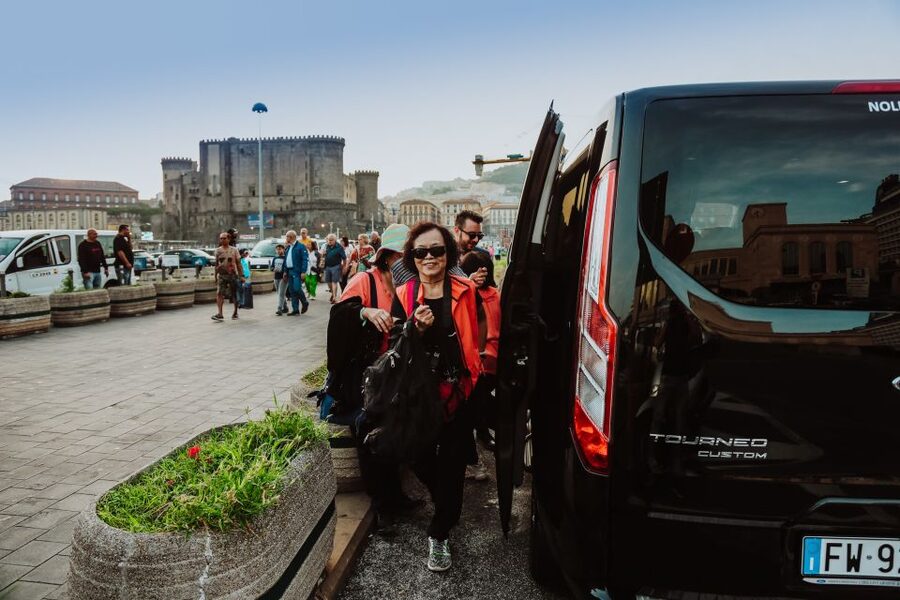
The day begins outside the entrance to Starhotels Terminus, opposite Naples Central Station. Look for the guide holding an Askos Tours sign. The driver and guide meet you there before the group boards a shared modern minibus.
The location is practical if you are arriving by train or staying near the station. Be punctual: the driver waits up to five minutes for late arrivals, then the tour needs to keep moving to fit both sites into the day. Bring a passport or ID card, and leave large bags and luggage behind. They are not allowed on the tour.
The drive to Herculaneum takes about 45 minutes. The return route from Pompeii to the meeting point is also listed at about 45 minutes, while the transfer between the two archaeological sites takes around 30 minutes. A minibus saves you from arranging separate transport and gives the group a direct link between the day’s stops.
The vehicle is described as modern, and visitors have praised the transport and driving. Still, shared minibus seating can feel snug, and one person noted that they would have liked more room. If you are tall or need extra space, keep that in mind.
More Pompeii visits near Naples:
- From Naples: Pompeii Ruins & Mount Vesuvius Day Tour
★ 4.3 · 11,459 reviews - Naples or Sorrento: Full-Day Pompeii and Mount Vesuvius Tour
★ 4.6 · 4,235 reviews - Pompeii & Mt.Vesuvius Day Tour from Naples with Pizza Lunch
★ 4.0 · 2,901 reviews
Herculaneum: small scale, remarkable preservation
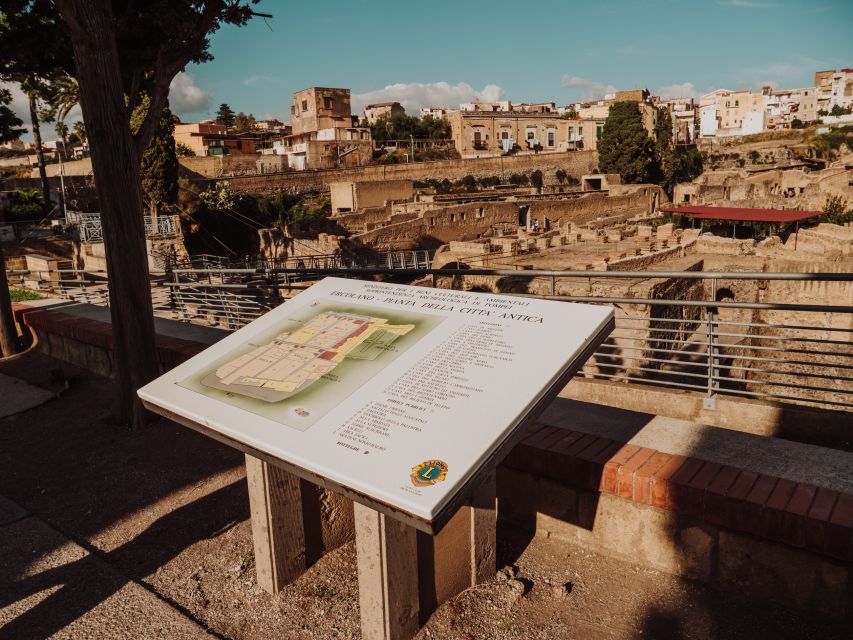
You spend about two hours on a guided walk through Herculaneum. Skip-the-line entry gets you past the ticket queue, leaving more of the visit for the site itself. The ruins were buried under a landslide of mud about 20 metres deep, a different process from the volcanic ash that covered Pompeii.
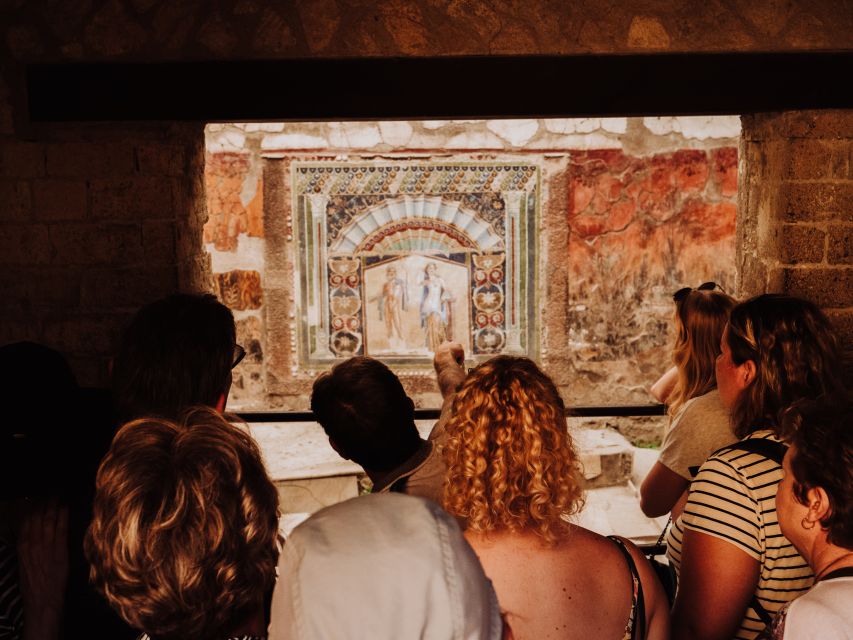
That burial helped preserve striking traces of daily life. Your guide can point out carbonized wooden objects, surviving paintings, and mosaics, details that can make the houses feel less abstract. The route may include the Temple of the Augustali, the Thermal Baths, the Forum, the Samnite House, the Gymnasium, and the House of the Dears.
One of the most sobering stops is the beach area where more than 300 skeletons were found. It brings the eruption’s human cost into view. The ruins are not simply a collection of architectural features; they are also the remains of people who sought shelter as the disaster unfolded.
Herculaneum rewards close attention. A guide can explain why a painted wall or a timber fragment matters, and point out small details that are easy to walk past on your own. The site’s more compact scale also makes it a good first stop before the broader streets and larger public spaces of Pompeii.
The transfer and lunch break
After Herculaneum, the minibus takes you to Pompeii. There is a lunch break before the guided walk, described as roughly 40 to 45 minutes. Meals are not included, so bring food or plan to buy lunch during the stop.
That pause is useful, but it is not a long meal. One person found the restaurant option expensive, around €30 per person, so carrying your own food is a sensible way to control costs if you prefer not to eat there. Check what is available on the day rather than counting on a particular meal or service.
You will want water and a little energy before the second site. Pompeii’s guided walk lasts about two hours, and the ground is uneven. Comfortable walking shoes matter more here than smart sightseeing clothes.
Pompeii: streets, shops, and civic life

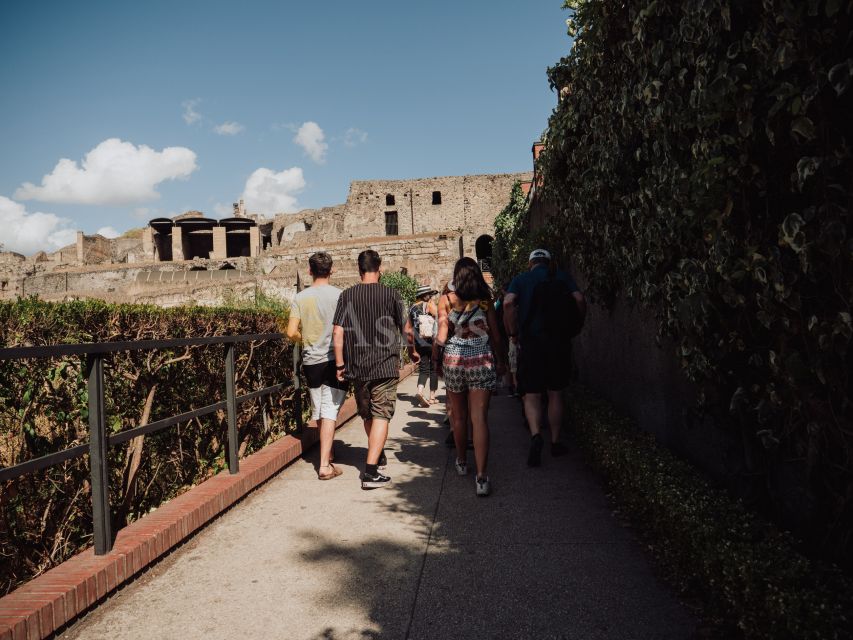
After lunch, you enter Pompeii with a skip-the-line ticket and follow a guided route through the ancient city. The tour begins near Marina Gate and takes in major public and private spaces. Stops include the Basilica, Forum, Forum Baths, Lupanar, bakery, House of Faun, Termopolium Capuano, House of the Tragic Poet, and the plaster casts.
The variety is part of Pompeii’s appeal. The Forum and Basilica show how the town handled civic life, while shops and food outlets offer clues to ordinary commerce. Houses such as the House of Faun reveal the size and decoration of wealthier homes. The plaster casts, made from spaces left by victims’ bodies in the ash, are a stark reminder that the city’s destruction was not just a distant geological event.
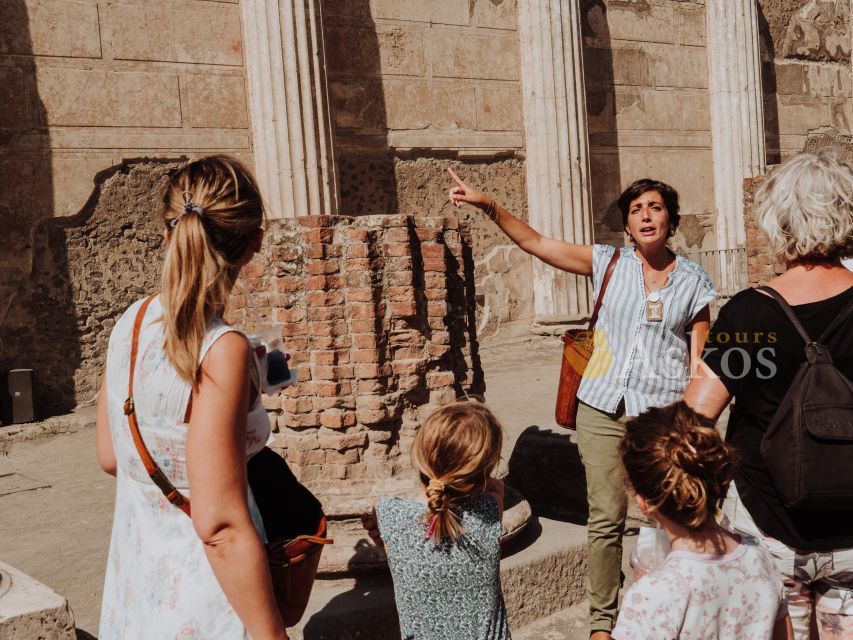
The guide’s role is especially useful here. Pompeii can feel overwhelming because the site is large and the visitor has to choose which way to turn at every junction. A focused route helps you see significant buildings while learning how Romans lived, worked, and used public space. Guides on different departures have included Raphael, Roberta, Gennaro, Vito, Julia, and Alfredo; the guide assigned to your date may differ.
Two hours is enough to cover a strong selection of highlights, but it will not let you linger everywhere. Some people may wish for more time to look closely at the rooms and objects. If you are drawn to one particular house or want to explore beyond the group route, consider a separate return visit rather than expecting this day to cover all of Pompeii.
More Herculaneum visits near Naples:
- Herculaneum: Skip-the-Line Guided Tour with Archaeologist
★ 4.8 · 3,439 reviews - Herculaneum Small Group Tour and Ticket With an Archaeologist
★ 5.0 · 994 reviews - Herculaneum: Skip-the-Line Entry Ticket with Audio Guide
★ 4.3 · 870 reviews - From Naples: Pompeii, Herculaneum, & Vesuvius Full-Day Tour
★ 3.9 · 602 reviews
What the archaeologist guide adds
The most consistently praised part of this outing is the guide. Archaeological knowledge matters because the remains need interpretation: a threshold, painted wall, or street layout can tell you something about Roman life, but only if you know what you are looking at. An effective guide turns those fragments into a readable picture of the town.
Several guides have been singled out by name on different departures, including Raphael, Roberta, Gennaro, Michele, and Julia. Michele has worked at Herculaneum, while other guides have been praised for explaining small details, answering questions, and keeping the day lively. These are examples of guides who have led the tour, not a promise that you can select a particular person.
The group limit of 20 helps keep the walk personal without making it a private tour. Guides have been praised for managing the pace and keeping people together in busy areas. You can ask questions, but remember that the group has a fixed schedule and two sites to cover.
Is $168.79 good value?
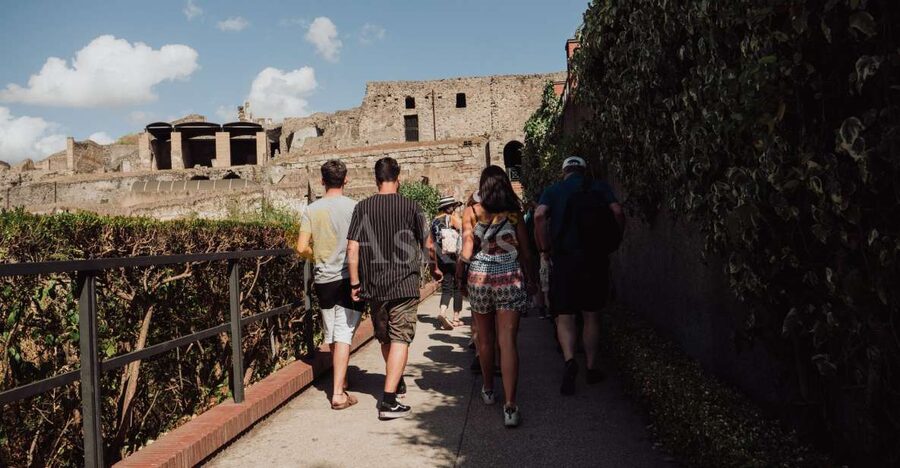
At $168.79 per person, the tour is not a budget outing. The price includes shared minibus transport, the Pompeii Express ticket, Herculaneum admission, an archaeologist guide, tolls, and parking. Lunch is extra. The Herculaneum ticket is listed at €16, and the cost of the Pompeii ticket is included in the tour price.
The value comes from combining two major sites in one day without having to work out transport, buy the separate entries, or navigate each place alone. Skip-the-line access is helpful when queues are long, though it does not make the sites quiet or empty. You are paying for a planned route and expert context as much as for the ride.
If you prefer to spend half a day in one house or take long breaks, you may get better value from visiting independently and giving yourself more time. If your schedule is tight, or you want an archaeologist to point out what matters, the bundled day is a practical use of your time and money.
Pace, comfort, and who should book
This is a full seven-hour day, including transfers, guided walks, and the lunch pause. Expect plenty of walking over uneven surfaces, slopes, and stairs. The tour is not recommended for people with limited mobility and is not suitable for wheelchair users. One person with previous Pompeii experience warned that the climbs and descents can be demanding.
Wear comfortable shoes and be ready for changing weather. The tour runs rain or shine, so bring a raincoat if rain is forecast. Baby seats are available on request. Large bags and luggage are not allowed, which is worth planning around if you are travelling onward from Naples the same day.
I would choose this outing if you want a strong first look at both sites and value a guide’s explanations. It suits visitors who can walk for several hours and are comfortable following a set schedule. It is less suitable if you have mobility concerns, need generous rest periods, or want to explore every corner at your own pace.
Should you book this Pompeii and Herculaneum tour?
Book it if you want to see both towns in one day, prefer a guide to explain the archaeology, and would rather have transport and entry arranged for you. The strongest reason to go is the contrast between Herculaneum’s preserved domestic details and Pompeii’s wider civic world.
Skip it if two hours per site sounds too rushed or the walking is likely to be uncomfortable. You can see the highlights here, but you cannot see everything. Bring your ID, wear sturdy shoes, plan for lunch, and treat the tour as an informed introduction rather than the last word on either site.
FAQ
Where does the tour start?
Meet outside the entrance to Starhotels Terminus, opposite Naples Central Station. Look for the guide holding an Askos Tours sign.
How long is the tour?
The tour lasts seven hours, including transport, guided visits, and a lunch break. Starting times depend on availability.
How much time do I get at Herculaneum?
The guided visit at Herculaneum lasts about two hours.
How much time do I get at Pompeii?
The guided walk at Pompeii lasts about two hours. There is also a lunch break of roughly 40 to 45 minutes before the visit.
Are entrance tickets included?
Yes. The Pompeii Express ticket and Herculaneum entrance ticket are included.
Is lunch included in the price?
No. Meals are not included. You have a break before the Pompeii visit and can bring food or buy lunch.
What language is the tour in?
The live guided tour is in English.
Is the tour suitable for wheelchair users?
No. The tour is not suitable for wheelchair users and is not recommended for people with limited mobility.
What should I bring?
Bring a passport or ID card. Comfortable walking shoes are advisable, and you should bring a raincoat if needed.
Can I bring luggage or a large bag?
No. Luggage and large bags are not allowed on the tour.
Recently added near Naples
- Private Natural Wine Vs Byodinamic and Organic Wine Tour★ 5.0 · 6 reviews
- Tiramisù Making Class With Limoncello or Meloncello Tasting★ 5.0 · 17 reviews
- Caserta Royal Palace tour★ 5.0 · 4 reviews
- Tour in the Charterhouse of St. Martin and Pedamentina with an art expert★ 4.5 · 3 reviews
- Private City Kickstart Tour: Naples★ 5.0 · 7 reviews
- Caserta Royal Palace Private Walking Tour★ 4.5 · 12 reviews
- Caserta Royal Palace small group tour★ 5.0 · 6 reviews
- Caserta Royal Palace Entrance Ticket★ 3.5 · 78 reviews
Herculaneum Tours, compared.
Herculaneum: Skip-the-Line Guided Tour with Archaeologist
Read our review →
Pompeii and Herculaneum Small Group Tour with an Archaeologist
Read our review →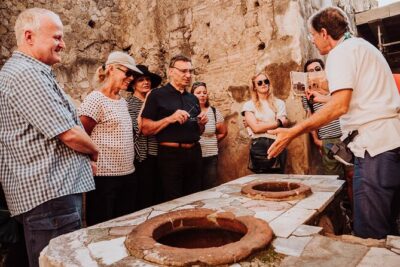
Herculaneum Small Group Tour and Ticket With an Archaeologist
Read our review →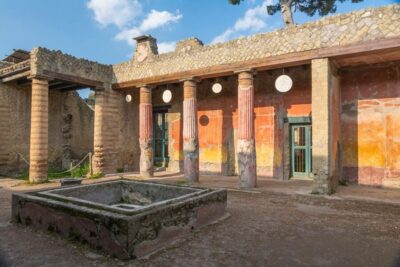
Herculaneum: Skip-the-Line Entry Ticket with Audio Guide
Read our review →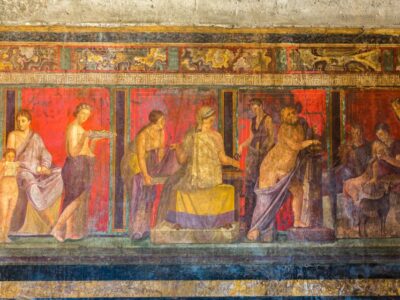
Pompeii, Herculaneum, & Vesuvius Full-Day Tour
Read our review →
Ercolano: Herculaneum Entry Ticket with Optional Audio Guide
Read our review →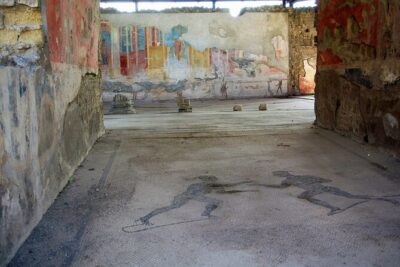
Day Trip of Pompeii, Herculaneum and Vesuvius from Naples
Read our review →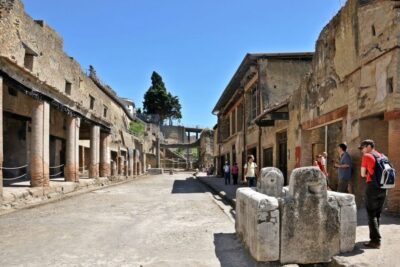
Browse the lists this tour appears in