
Reviewed · HERCULANEUM TOURS
Pompeii and Herculaneum: Guided Tour with an Archaeologist
The eruption of Vesuvius buried two Roman towns, but it preserved them in strikingly different ways. This five-hour tour pairs Pompeii’s broad streets and public buildings with Herculaneum’s unusually well-preserved homes, giving you a more complete picture than either site alone.
I like two things here: an archaeologist leads the walk, and the group stays small, with up to 10 people. The guide, Benedetto, is praised for mixing detailed explanations with humor, adapting to questions and steering around crowds when possible.
The main trade-off is the pace. You’ll spend hours on foot, cover two separate sites and have only an hour for lunch. Transport and food are extra, and the tour is not suitable for wheelchair users or people with mobility impairments.
What makes this tour worth considering
- Two sites, two kinds of preservation: Pompeii gives you a city plan and public life; Herculaneum offers remarkably preserved interiors, wood and household objects.
- An archaeologist at the helm: Benedetto brings field experience to the explanations, with history and everyday details woven into the walk.
- A small group: The group size is capped at 10, a practical advantage in busy Pompeii’s narrow streets and popular buildings.
- A useful lunch pause: You get an hour between sites, but you’ll need to pay for your own meal.
- Tickets are included: You can skip the ticket line, but Pompeii’s named tickets require the full names of all participants in advance.
Two buried towns, not one repeat visit
Pompeii and Herculaneum are often grouped together because both were overwhelmed by Vesuvius in AD 79. Seeing them on one day is not simply a way to check off two archaeological parks. Their differences help explain how the same disaster could leave distinct traces, and how much daily life can be read from streets, rooms and objects.
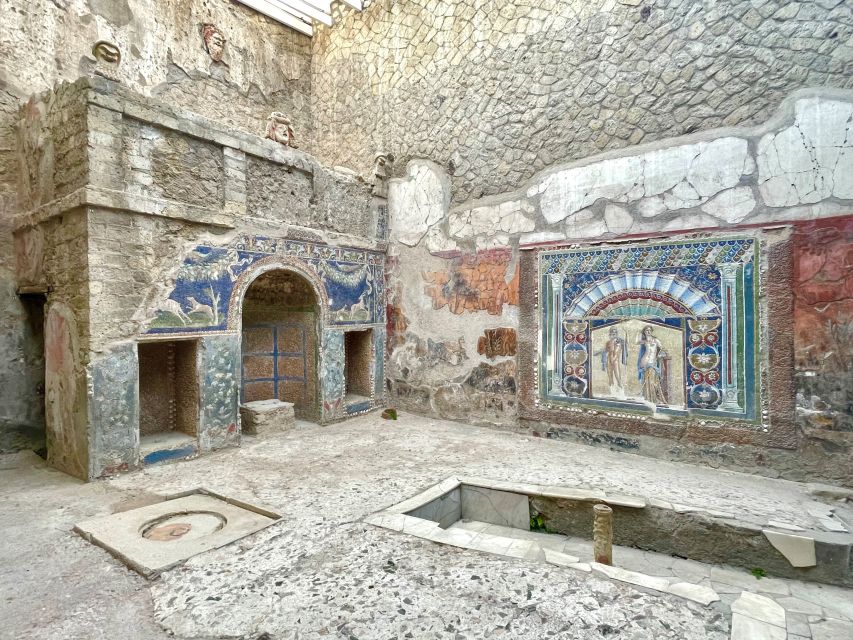
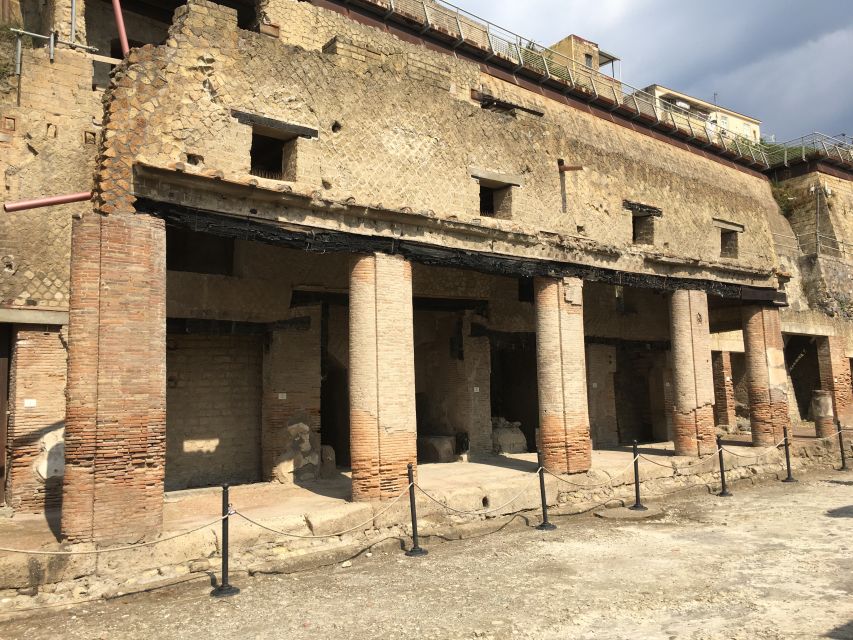
Pompeii is the larger, more expansive city. Its remains help you imagine public life as well as domestic routines: shops, bakeries, snack bars, baths, theatres and civic buildings. Herculaneum is smaller, but its state of preservation can make a room feel startlingly immediate. The tour draws on both settings to show how Romans lived, rather than treating the sites as a collection of ruins and dates.
That comparison is the chief reason I’d consider this itinerary. A guide can connect the two places and help you notice what differs: the layout of a city, the decoration inside a home, and the materials that survived. With an archaeologist leading the way, you can also ask questions as they arise instead of trying to piece everything together from signs.
More Pompeii visits near Pompei Campania:
- Pompeii: Entry Ticket and Guided Tour with an Archaeologist
★ 4.8 · 19,459 reviews - Pompeii: Small Group Tour with an Archaeologist
★ 4.8 · 12,264 reviews - Pompeii: Skip-the-Line Entrance Ticket with Audio Guide
★ 4.0 · 2,509 reviews
Pompeii begins at the Porta Marina Inferiore
The tour starts at the meeting point by Suisse Restaurant, near the Porta Marina Inferiore entrance. From there, the walk heads through the area of the theatres before moving into ancient houses and the streets of the city. The order gives you a broad sense of Pompeii before focusing on details inside its buildings.
The advertised guided visit to Pompeii lasts about two hours. That is enough time to see a selection of important places, but not to explore every corner of this large site. Think of the tour as a guided introduction, not a full-day survey. You’ll benefit most if you are ready to keep moving and let the guide choose which buildings best tell the story.
Inside the houses, look for mosaics, frescoes and marble decoration. These details are more than visual treats: they help you picture how residents marked out rooms and displayed wealth. Benedetto’s archaeological background can make the difference between passing a painted wall and understanding what you are looking at.
The route also passes shops, bakeries and snack bars. These everyday businesses give Pompeii a human scale. A bakery or a counter where people once stopped for food can make the city feel less like a distant monument and more like a place built around ordinary routines.
Next come the public baths and the Lupanare, the famous brothel. These stops reveal different sides of Roman urban life, from communal facilities to more private commerce. The guide’s role is especially useful here: context can help you read a building without reducing it to a quick spectacle or a single sensational fact.
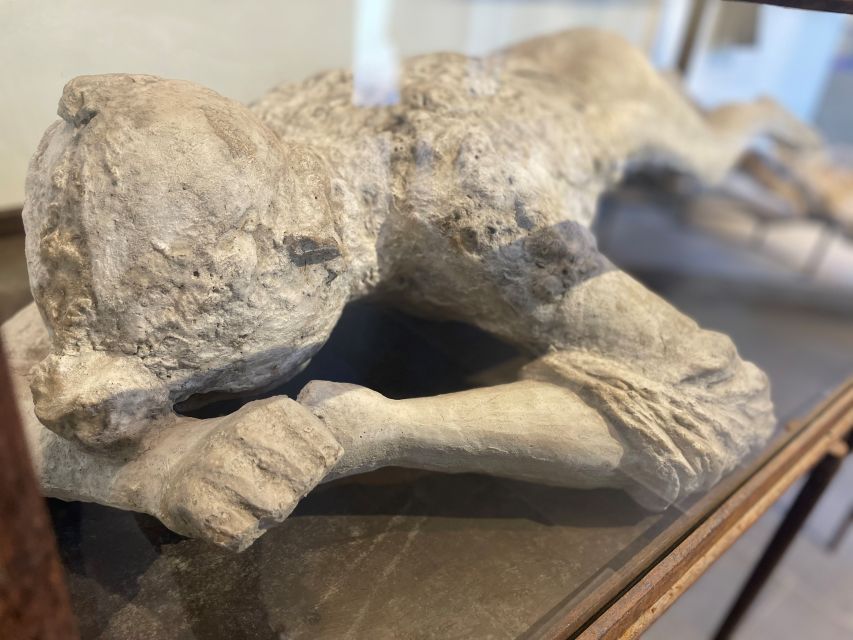
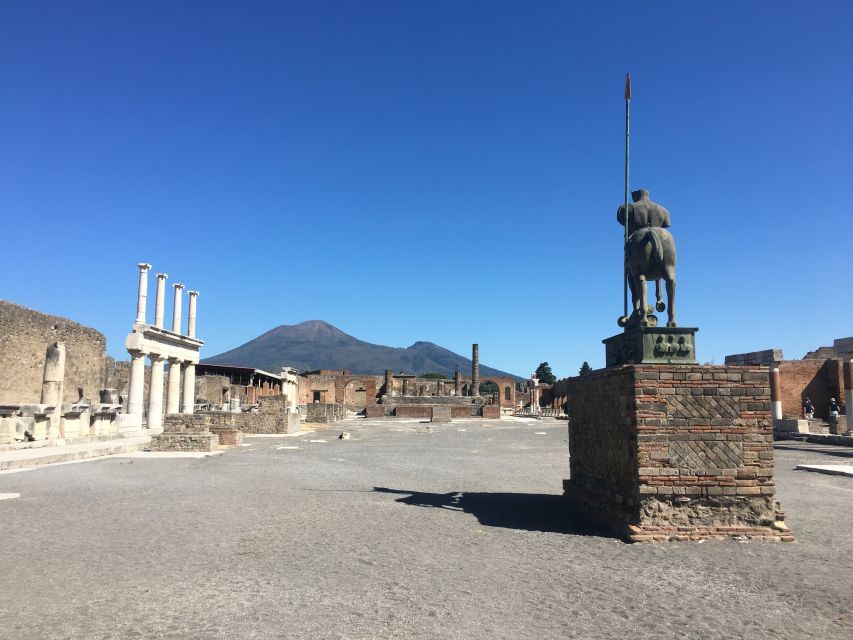
The Forum rounds out the Pompeii visit. This was the city’s civic centre, with public buildings arranged around an open space. Plaster casts of victims are also part of the visit. They are among the site’s most affecting sights, and they give the eruption’s human cost a direct presence. Take your time with them, even if the group is continuing on.
Pompeii can be crowded, particularly around famous buildings. A small group gives the guide more room to move and makes it easier to hear and ask questions. Benedetto is noted for adjusting the route to avoid larger groups where possible, but no guide can make a popular archaeological site empty. Expect other groups and allow patience at busy points.
The lunch hour is useful, but plan to pay
After Pompeii, you get a one-hour lunch break. Food and drink are not included, so bring money and use the time to eat, rest and drink water before the second site. The nearby Suisse Restaurant is mentioned as an option for food, but choosing it is up to you.
This pause matters. The total visit is five hours, and the day involves sustained walking in two outdoor archaeological sites. The advice to bring water, a hat and comfortable shoes is practical, not decorative. In warm weather, the break is also a chance to cool down before continuing.
The break does not turn the tour into a leisurely day with long café stops. An hour has to cover your meal and the transition to Herculaneum, so keep lunch simple if you want to use the full guided visit there. If you need extra time to sit or eat, you may have to accept a shorter pause elsewhere.
Herculaneum changes the scale of the story
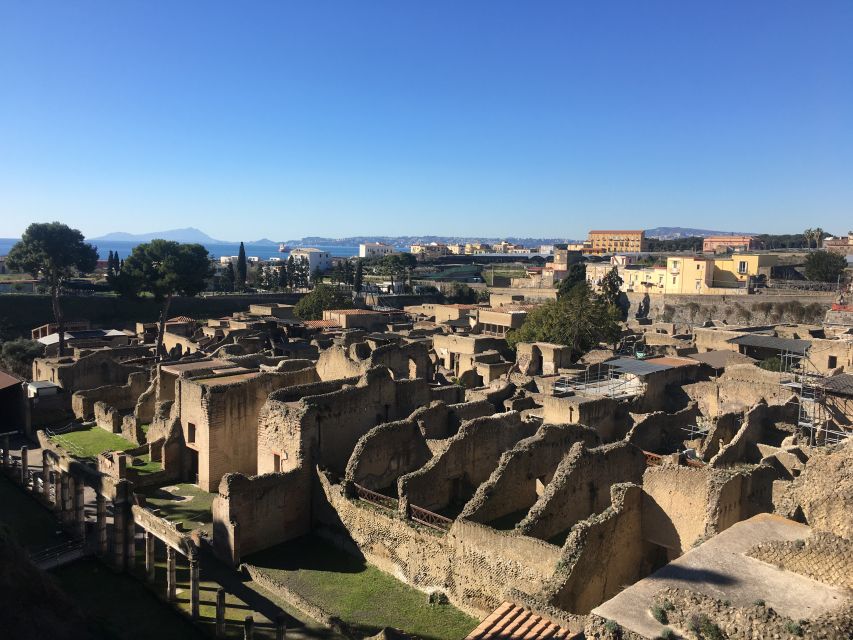
The group then travels to Herculaneum by train. The journey is described as about 20 minutes, while the itinerary allows 30 minutes, so plan for a short transfer rather than a precise arrival time. Transportation is not included in the price, and you should budget separately for it.
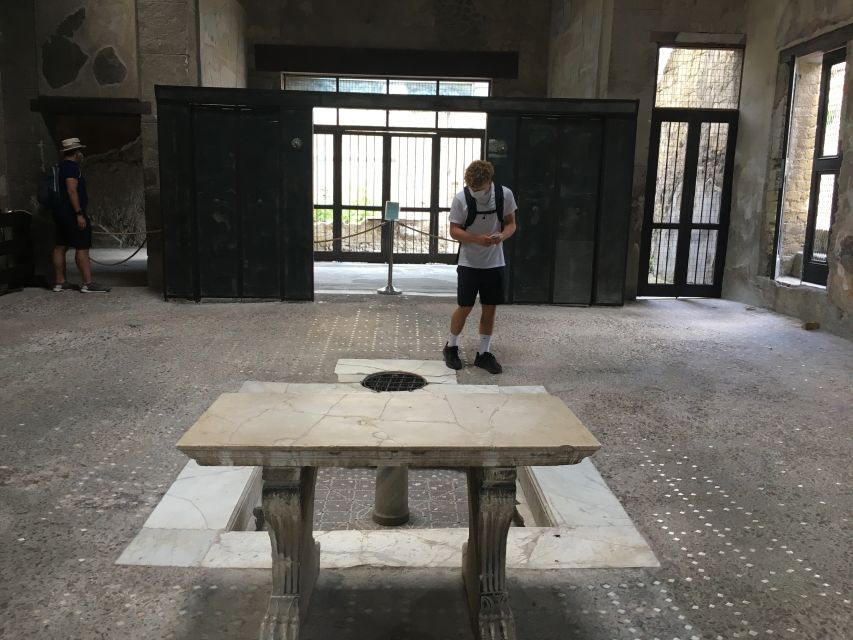
Herculaneum is the smaller site, but its preservation makes it an important counterpart to Pompeii. The walk highlights residences with frescoes, marble and mosaics, as well as jewelry, skeletons and exceptionally well-preserved wood. These surviving materials can make domestic spaces feel unusually detailed and tangible.
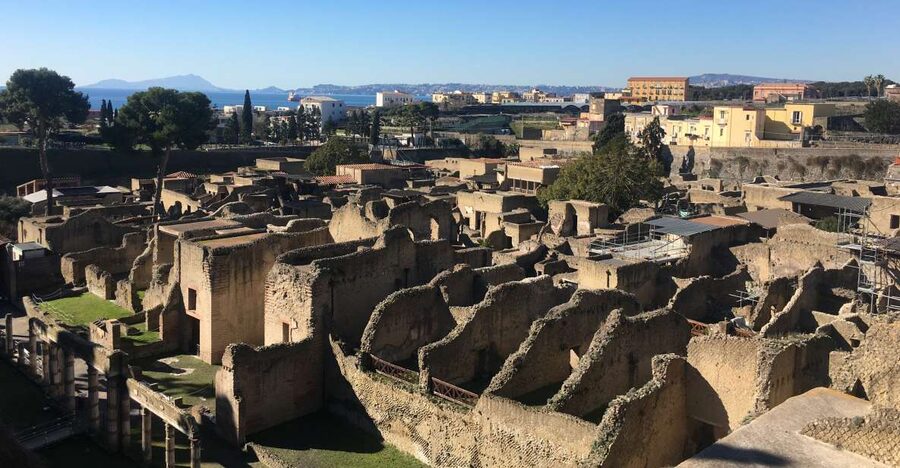
The guided visit lasts about an hour and a half. That is a generous amount of time for a focused introduction, especially after the earlier visit, but it still calls for prioritizing. You will not see every part of the site. The point is to notice how homes and their contents add another layer to the picture of Roman life.
Herculaneum is often quieter than Pompeii, which can make it easier to focus on the buildings and listen to the guide. It is also a particularly rewarding stop for photography and archaeology enthusiasts. If you are choosing between the two sites, the itinerary’s strongest argument is that you do not have to choose: the contrast is part of the experience.
The stated route finishes at the Archaeological Park of Herculaneum. There is, however, a conflicting note in the meeting details saying the activity ends back at the starting point. Confirm the exact end arrangement before booking, especially if you have a train, taxi or other onward plans.
More Herculaneum visits near Pompei Campania:
- Pompeii: Small-Group Tour of Pompeii and Herculaneum
★ 4.8 · 867 reviews - From Naples: Pompeii and Herculaneum VIP Tour with Lunch
★ 4.4 · 129 reviews - Pompeii & Herculaneum: Skip-the-line & Digital Guide App
★ 4.0 · 35 reviews - Pompeii, Herculaneum, and Vesuvius: Full-Day Tour
★ 3.7 · 21 reviews
What an archaeologist adds to the walk
Benedetto is the guide named throughout the tour information. He is described as a professional archaeologist, and participants have found his field knowledge particularly useful for understanding both sites. One account mentions that he holds a doctorate in archaeology, but the core reason to book is simpler: the tour is led by someone who can explain the evidence, not just point out the famous sights.
The style sounds lively and conversational. Benedetto is described as funny, patient and good at answering questions, including when children are in the group. His explanations connect archaeology with history and daily life, which can help keep a long walk engaging for adults and younger visitors alike.
His practical help is another plus. He has offered advice about getting to the meeting point, helped with lunch choices and arranged taxis for people who wanted an alternative to the train. Those are helpful gestures, but they should not be treated as included transport or guaranteed services. The tour’s listed plan uses the train, and travel costs remain your responsibility.
Small groups also make a difference to the guide’s teaching. With no more than 10 people, there is more chance to hear an explanation and ask a follow-up than there would be in a large coach group. Headsets are provided for groups larger than eight, which is useful when the group is near other tours or spread out along a street.
Price, pace and who should book
At $141.61 per person, the price includes an archaeologist guide and entry tickets to both sites. The value rests on the two-site format and the specialist guidance. If you visited independently, you would still need to arrange admission and make sense of the sites on your own; here, the guide provides structure and helps connect what you see at Pompeii to what you encounter at Herculaneum.
The price does not include lunch or transportation between the sites. Factor those costs into your budget, along with any onward travel after Herculaneum. Skip-the-ticket-line access saves time at admission, but it does not mean you avoid crowds inside the parks.
This is a strong fit if you want an informed overview, enjoy asking questions, or are visiting Pompeii and Herculaneum for the first time. Families can benefit from the guide’s ability to explain the ruins in an accessible way, and the two sites give photography and archaeology enthusiasts plenty to notice. The tour is available in English, Italian and French.
It is less suitable if you want a slow, independent day, need a long lunch or have difficulty walking. The five-hour schedule includes two guided visits, a break and a transfer, so you should be comfortable spending much of the day on your feet. The activity is not suitable for wheelchair users or people with mobility impairments.
Bring your original passport or ID card, comfortable shoes, a hat and water. Pompeii tickets are issued in each participant’s name, so you must provide everyone’s first and last name after booking. A private option is available if you prefer not to share the guide, while small-group options keep the group limited to 10.
Should you book this Pompeii and Herculaneum tour?
I’d book it if seeing both sites matters to you and you want an archaeologist to make the differences clear. Benedetto’s mix of detailed explanations, humor and practical help suits a day that could otherwise feel like a lot of ruins in a short time. The strongest reason to go is the pairing: Pompeii shows the scale of a Roman city, while Herculaneum gives you a closer look at remarkably preserved homes and objects.
Skip it if you need a flexible pace, want to spend most of the day at Pompeii alone, or cannot manage an extended walking tour. Before you reserve, confirm the tour’s exact ending point and budget for lunch and train fare. If those details work for you, this is a purposeful way to see two very different archaeological sites in one day.
FAQ
How long is the tour?
The tour lasts five hours. It includes about two hours of guided time in Pompeii, a one-hour lunch break, a transfer and about an hour and a half of guided time in Herculaneum.
Which languages are available?
The live guide is available in English, Italian and French.
How large is the group?
Private and small-group options are available. The small group is capped at 10 people, and headsets are provided for groups larger than eight.
Are entry tickets included?
Yes. Entry tickets to the archaeological sites are included, and the tour offers skip-the-ticket-line access.
Is transportation between Pompeii and Herculaneum included?
No. The transfer is by train, but transportation is not included in the tour price. The journey is described as taking about 20 minutes, with 30 minutes allowed in the itinerary.
Is lunch included?
No. You have a one-hour lunch break, but food and drink are not included.
What should I bring?
Bring your original passport or ID card, comfortable shoes, a hat and water.
Do I need to provide participants’ names?
Yes. Pompeii tickets are issued in each participant’s name. After booking, you need to provide the first and last name of everyone in your group.
Can I cancel for a refund?
You can cancel up to 24 hours in advance for a full refund.
Recently added near Pompei Campania
- Pompeii and Vesuvius Cellars: Tour with Pick-Up in Positano★ 4.7 · 3 reviews
- From Sorrento: Pompeii with an Archaeological Guide & Ticket★ 4.6 · 19 reviews
- From Positano: Pompeii Ruins Small Group Guided Tour★ 4.8 · 82 reviews
- From Naples: Pompeii Wheelchair-accessible with a Guide★ 5.0 · 8 reviews
- Pompeii Positano Amalfi Day Trip from Rome by Car, No Bus!★ 5.0 · 5 reviews
- Pompeii & Virtual Museum Private 2-in-1 Kid’s Tour★ 4.9 · 9 reviews
- Pompeii & Vesuvius★ 4.3 · 12 reviews
- Pompeii Tour_Skip the line ticket + audioguide★ 4.7 · 17 reviews
Herculaneum Tours, compared.
Herculaneum: Skip-the-Line Guided Tour with Archaeologist
Read our review →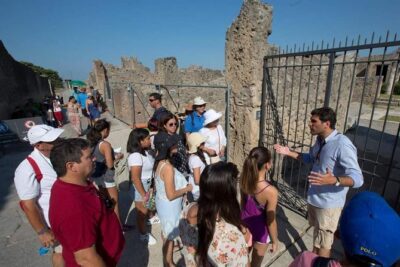
Pompeii and Herculaneum Small Group Tour with an Archaeologist
Read our review →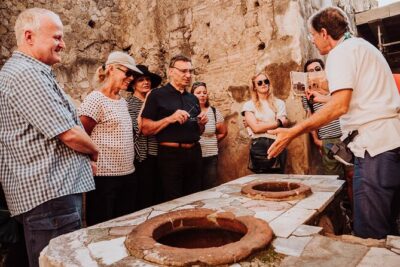
Herculaneum Small Group Tour and Ticket With an Archaeologist
Read our review →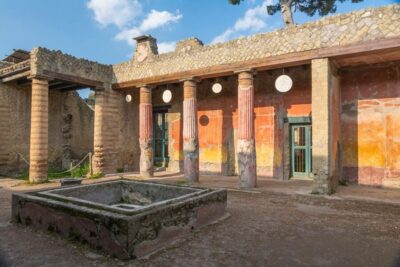
Herculaneum: Skip-the-Line Entry Ticket with Audio Guide
Read our review →
Pompeii & Herculaneum with Archaeologist Guide
Read our review →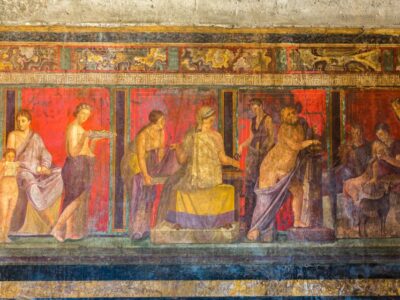
Pompeii, Herculaneum, & Vesuvius Full-Day Tour
Read our review →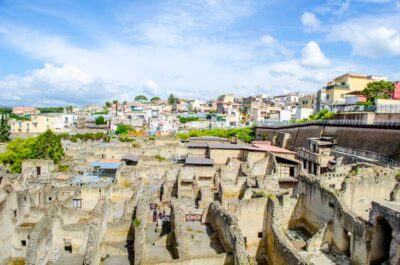
Ercolano: Herculaneum Entry Ticket with Optional Audio Guide
Read our review →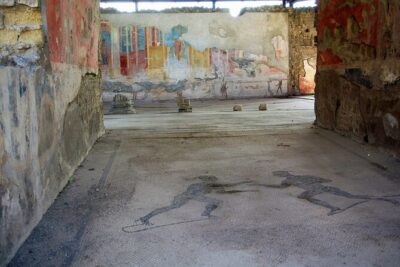
Day Trip of Pompeii, Herculaneum and Vesuvius from Naples
Read our review →Browse the lists this tour appears in